Where DGRO's Dividend Income Really Comes From
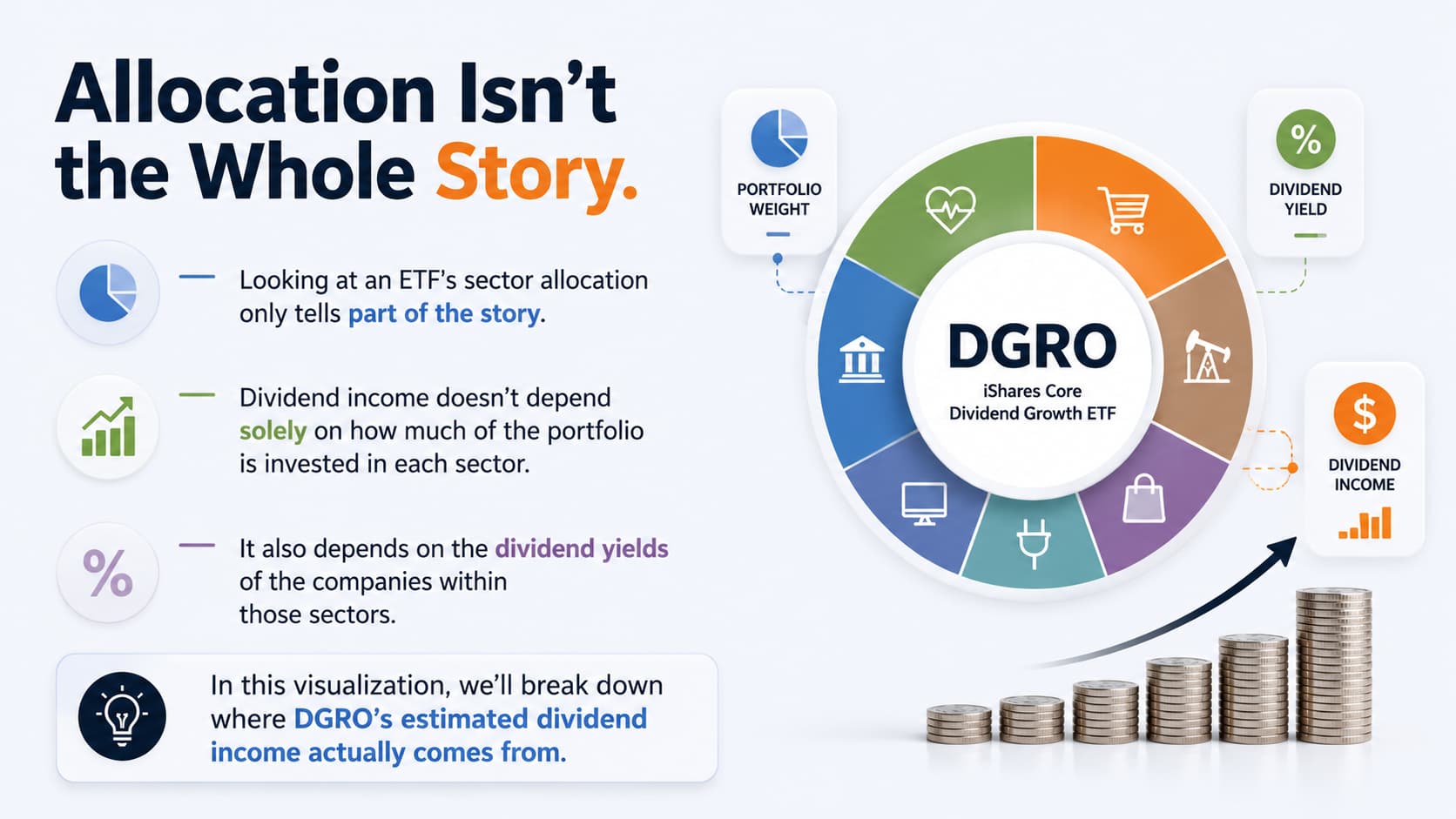
Dividend investors often look at an ETF's sector allocation to understand where its dividend income comes from.
However, portfolio weight tells only part of the story. The dividend yield of each underlying company also plays an important role in determining how much income each sector actually generates.
This analysis looks at the iShares Core Dividend Growth ETF (DGRO) through a different lens. Rather than focusing on every one of its 390 holdings, it examines the ETF's twenty largest positions, which represent just over 42% of the portfolio weight and an estimated 44% of its dividend income.
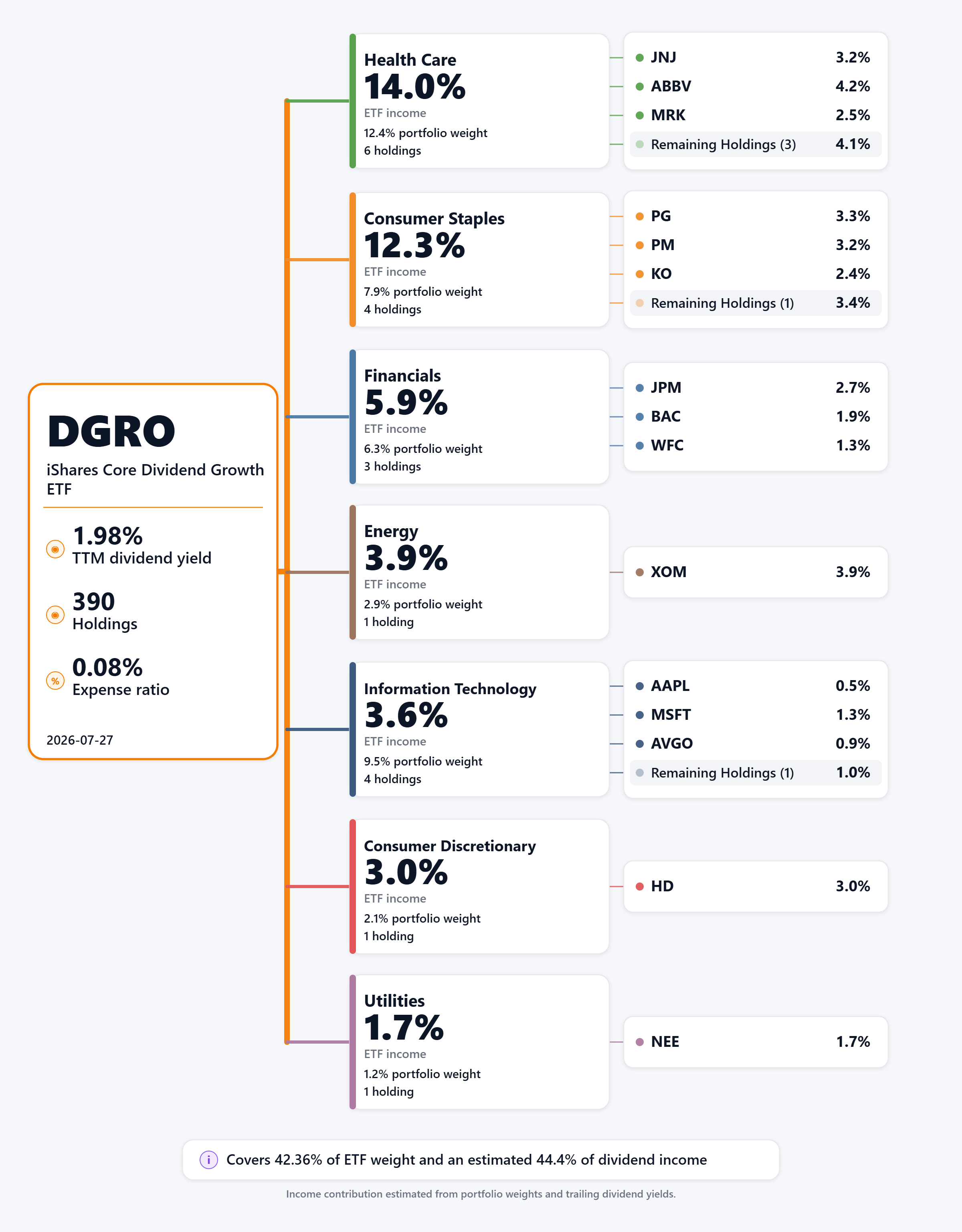
The visualization breaks down the estimated dividend income generated by DGRO's largest holdings by sector, making it easier to see which parts of the portfolio contribute the most cash flow.
Health Care emerges as the largest income-producing sector in this analysis. Although it accounts for only about 12.4% of the covered portfolio weight, companies such as AbbVie, Johnson & Johnson, and Merck combine meaningful allocations with relatively attractive dividend yields, allowing the sector to generate an estimated 14% of the dividend income.
Consumer Staples follows closely behind. Holdings including Procter & Gamble, Philip Morris, and Coca-Cola provide a combination of stable dividends and significant portfolio weights, making the sector another major contributor to DGRO's income.
One of the most interesting observations comes from Information Technology. Despite representing roughly 9.5% of the covered portfolio weight, the sector contributes only an estimated 3.6% of dividend income. Large technology companies such as Apple, Microsoft, and Broadcom generally offer lower dividend yields than many traditional dividend sectors, illustrating why portfolio size alone doesn't determine income generation.
The remaining income comes from sectors including Financials, Energy, Consumer Discretionary, and Utilities. Energy is a good example of how even a relatively small allocation can make a meaningful contribution when supported by a higher-yield holding such as Exxon Mobil.
Final Takeaway
Sector allocation helps explain where an ETF invests, but it doesn't fully explain where its dividend income comes from.
To understand an income-focused ETF like DGRO, it's important to consider both portfolio weight and the dividend yields of the underlying holdings. Looking at these factors together provides a clearer picture of how the fund generates its cash distributions and where investors' income is actually coming from.