Telecom Dividend Battle: VZ vs T vs BCE vs DTEGY
Portfolio Overview
In this DividendXray battle, we compare four major telecom dividend stocks across income growth, yield-on-cost expansion, and total return performance over a five-year period.
- Verizon (VZ) is one of the largest wireless providers in the United States, known for its high dividend yield and stable recurring cash flows.
- AT&T (T) combines nationwide wireless operations with a growing fiber broadband business, emphasizing income generation and network investment.
- BCE (BCE) is Canada's largest communications company, providing wireless, broadband, media, and business services backed by a long history of dividend payments.
- Deutsche Telekom (DTEGY) offers global telecom exposure and benefits from its majority ownership of T-Mobile U.S., providing a blend of dividend income and stronger growth characteristics than many traditional telecom operators.
Each company serves millions of customers through essential communications infrastructure, but their approaches to dividend growth and shareholder returns differ considerably.
Category Winners
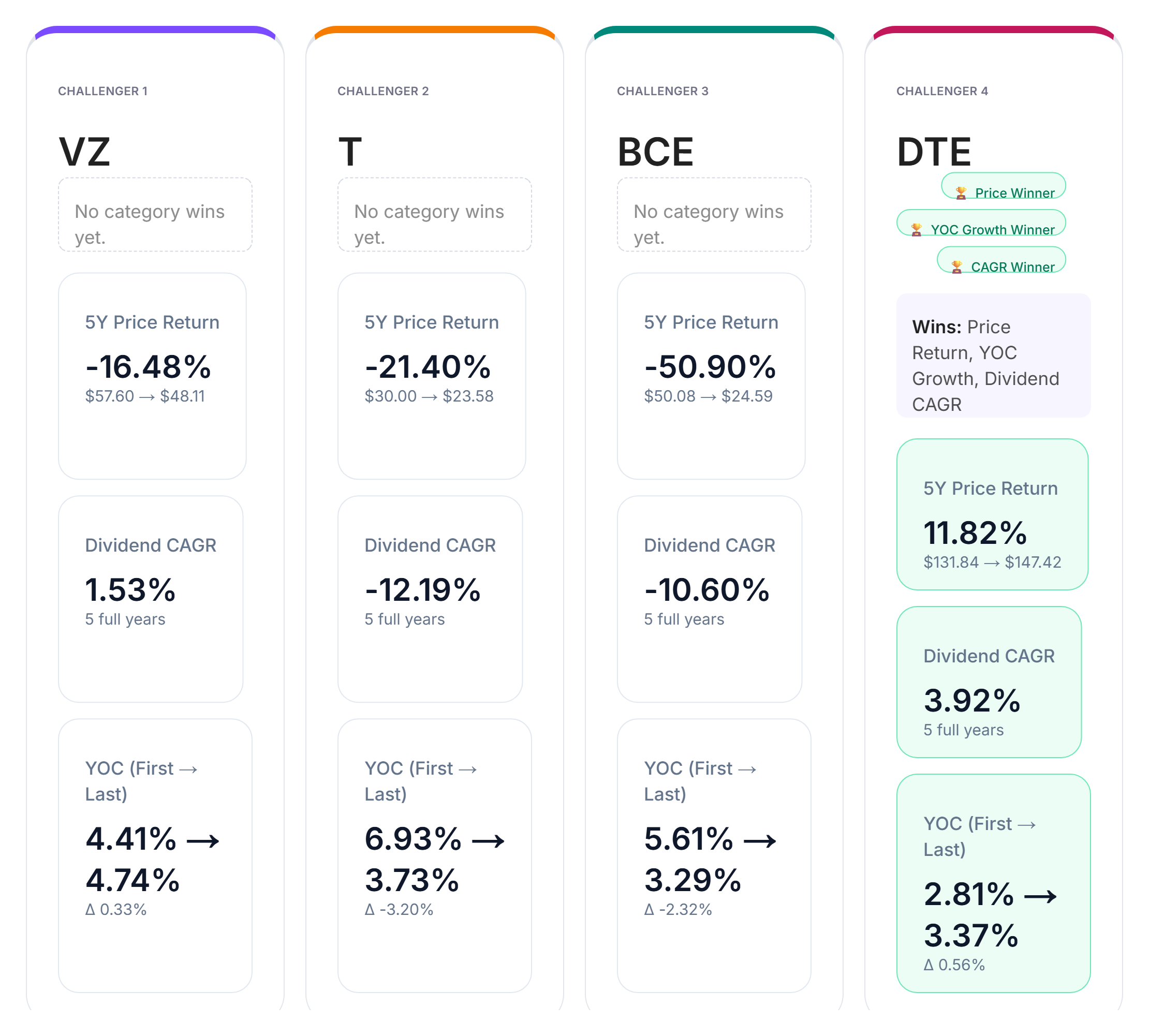
Looking at the data across dividend CAGR, yield-on-cost growth, and price return, clear category leaders emerge.
In dividend growth, Deutsche Telekom leads the group with a five-year dividend CAGR of 3.92%.
For yield-on-cost growth, Deutsche Telekom again shows the strongest improvement from the first year to the last, demonstrating the most efficient dividend income growth relative to the original investment.
In price return, Deutsche Telekom secures another victory with a five-year return of 11.82%, outperforming the other telecom challengers in total appreciation.
The remaining companies continue to provide meaningful income generation, but Deutsche Telekom stands out as the most balanced performer across growth-oriented categories in this comparison.
Yield-on-Cost by Year
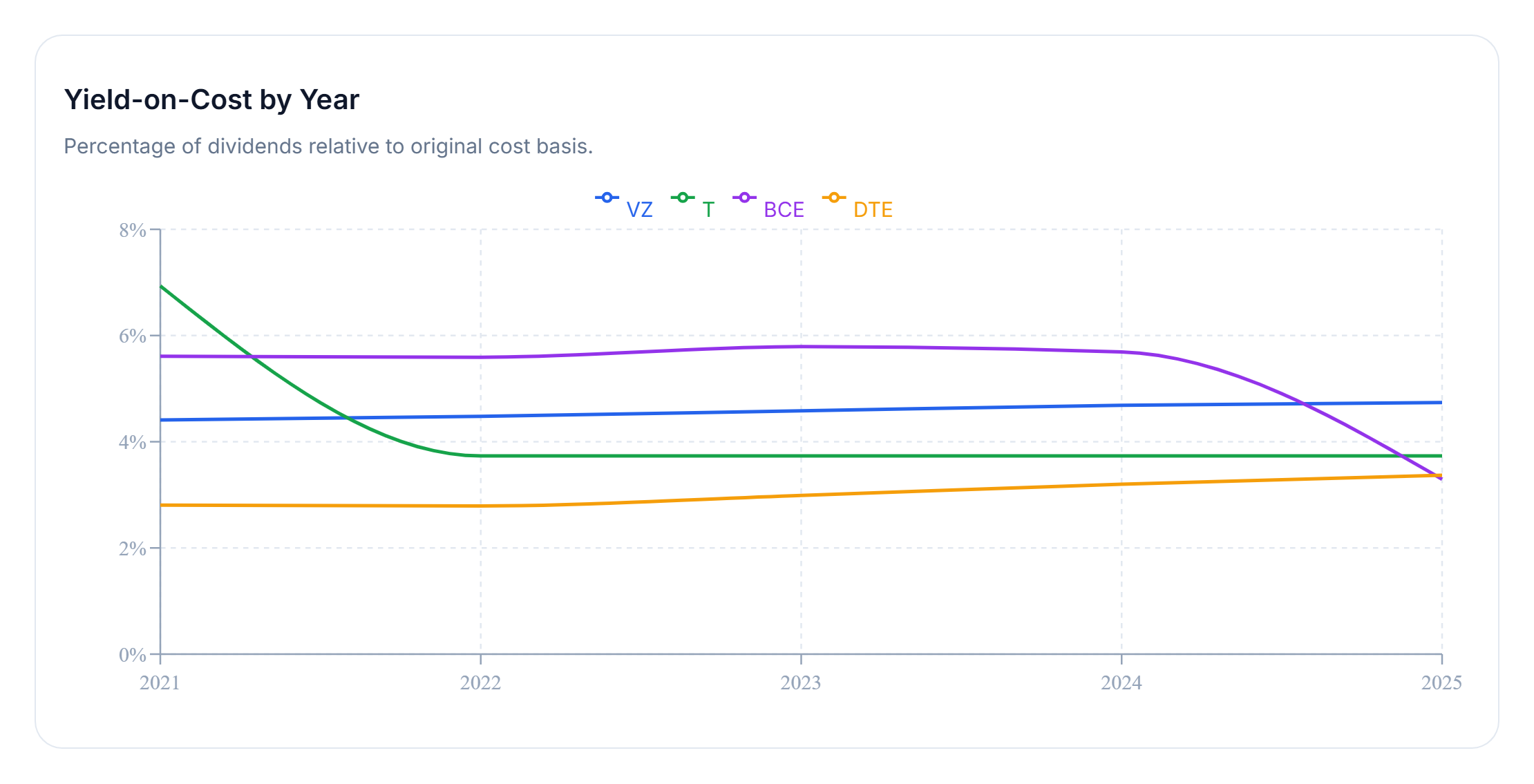
Yield-on-cost measures dividend income relative to the original capital invested. Unlike current yield, it reflects how efficiently a holding grows income over time.
Over the five-year period, Verizon stands out with the strongest income efficiency, reaching approximately 4.74% yield on cost by the end of the analysis.
AT&T, BCE, and Deutsche Telekom also demonstrate growing income streams, but Verizon ultimately generates the highest level of dividend income relative to the original investment amount.
For income-focused investors, this distinction is important. A higher yield on cost indicates stronger income production from the capital originally deployed, highlighting how different dividend strategies can produce different outcomes even within the same sector.
Final Takeaway
There is no single "perfect" telecom dividend stock. Each company offers a different balance between current income, dividend growth, and total return potential.
This battle shows that Deutsche Telekom currently dominates the growth-oriented metrics, leading in dividend CAGR, yield-on-cost growth, and price appreciation. Verizon, however, delivers the strongest yield-on-cost result, generating the highest level of income relative to the original investment.
Investors prioritizing maximum income efficiency may find Verizon attractive, while those seeking stronger dividend growth and capital appreciation may prefer Deutsche Telekom.
Ultimately, the best choice depends on whether your primary objective is maximizing present income, accelerating long-term dividend growth, or balancing both within a diversified dividend portfolio.