Retail Dividend Battle: Costco vs Home Depot vs Lowe's vs Target
Portfolio Overview
In this DividendXray battle, we compare four of the market's most recognizable dividend growth retailers across income growth, yield-on-cost expansion, and total return performance over a five-year period.
Costco (COST) combines exceptional business performance with one of the fastest-growing dividends in the retail sector. Home Depot (HD) pairs a reliable dividend with decades of shareholder-friendly capital allocation and consistent earnings growth. Lowe's (LOW) has built one of the strongest long-term dividend growth records among home improvement retailers. Target (TGT) offers the highest starting dividend yield in the group while continuing its long tradition of annual dividend increases.
Each company follows a different path to rewarding shareholders, balancing current income, dividend growth, and long-term capital appreciation.
Category Winners
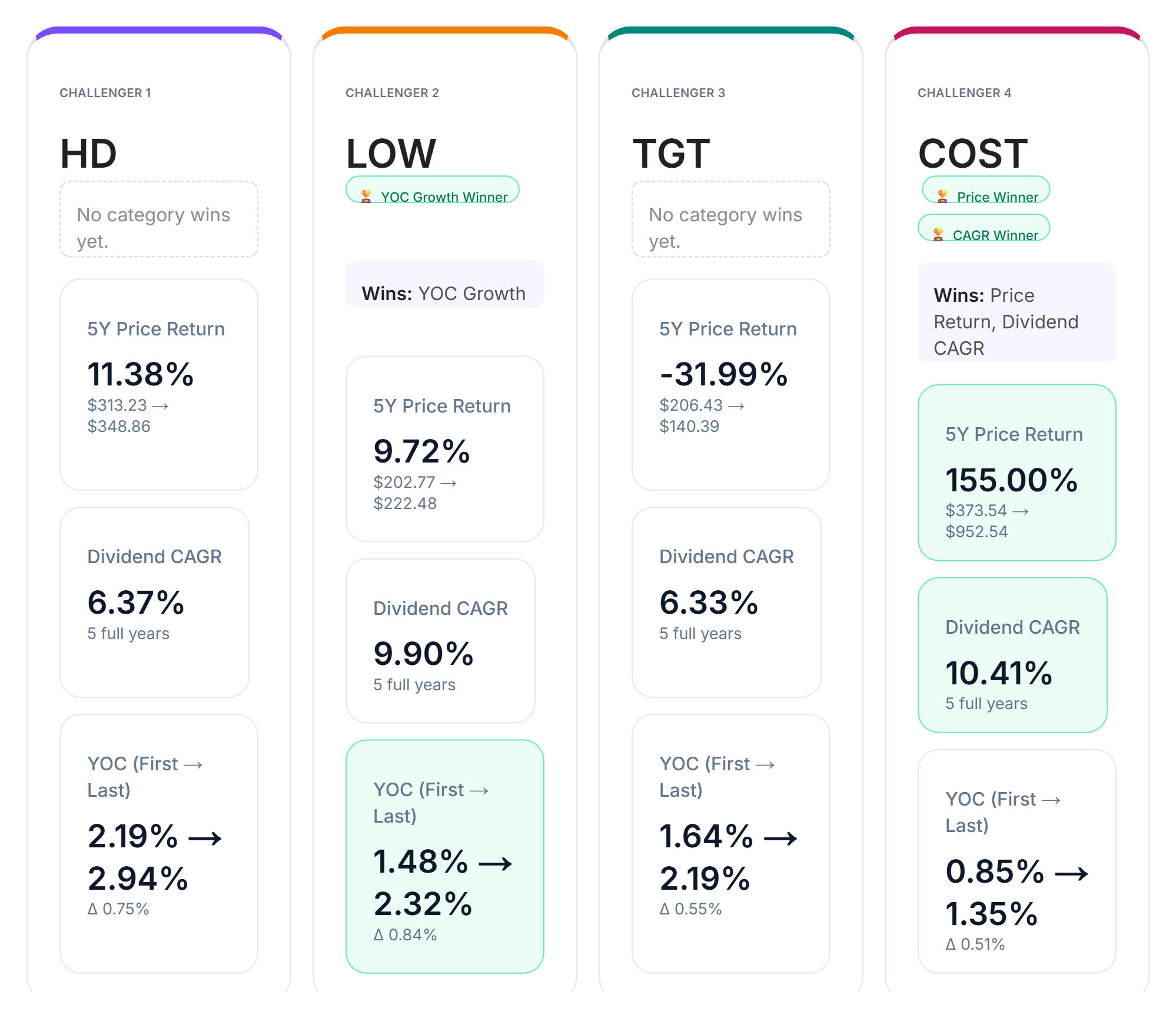
Looking at the data across dividend CAGR, yield-on-cost growth, and price return, clear category leaders emerge.
In dividend growth, Costco leads the group with a five-year dividend CAGR of 10.41%.
For yield-on-cost growth, Lowe's shows the strongest improvement from the first year to the last, highlighting its ability to compound dividend income efficiently over time.
In price return, Costco once again takes the lead with an impressive 155.00% five-year return, significantly outperforming the other retailers in capital appreciation.
Home Depot and Target deliver strong overall performance, but neither secures a category victory in this comparison. The results demonstrate how different dividend strategies can excel in different areas of long-term investing.
Yield-on-Cost by Year
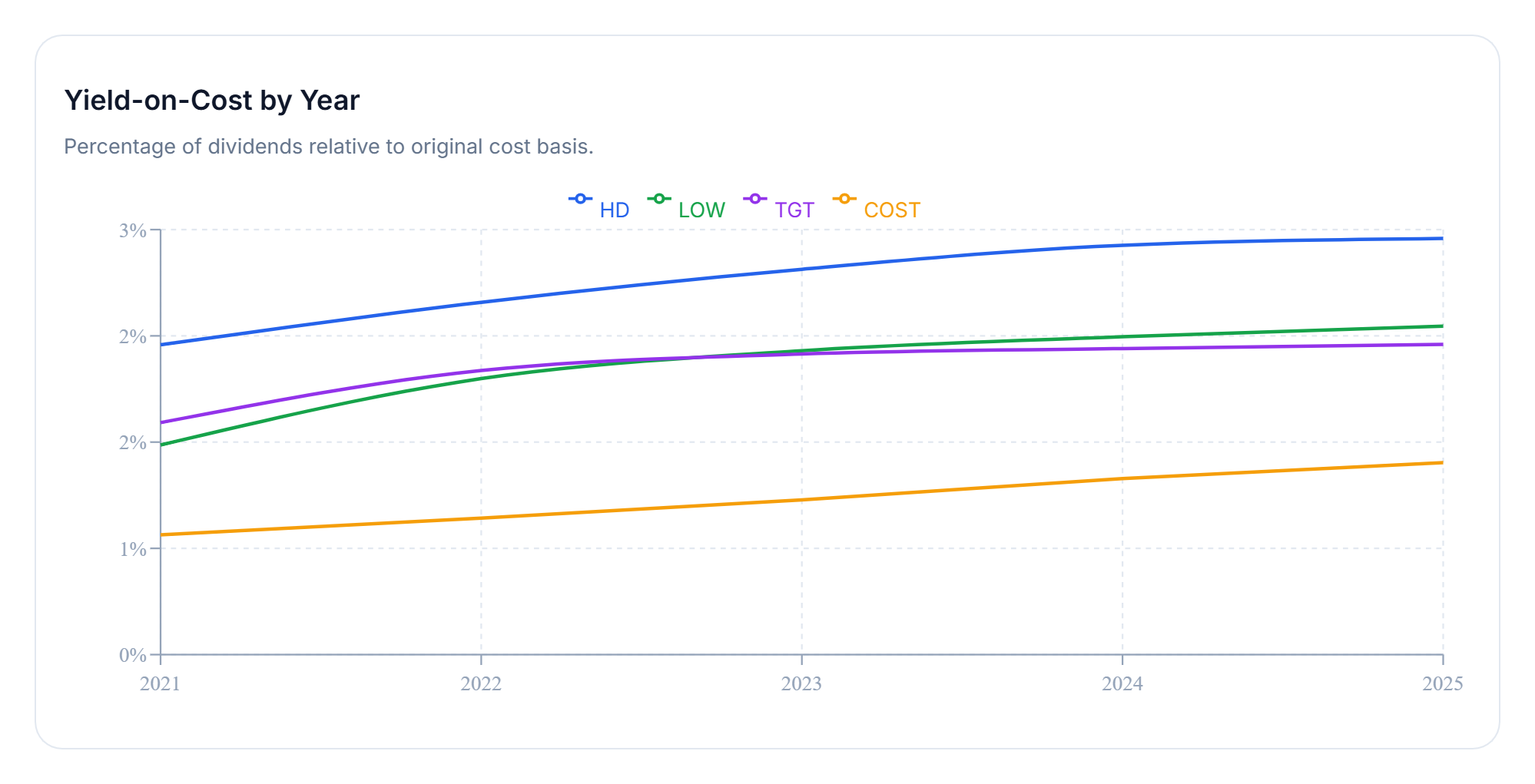
Yield on cost measures dividend income relative to the original capital invested rather than the stock's current market value. It provides a useful perspective on how efficiently a holding grows income over time.
Over the five-year period, Home Depot stands out with the strongest income efficiency, reaching approximately 2.94% yield on cost by the end of the analysis.
Costco, Lowe's, and Target also demonstrate steady upward income trends throughout the period. While annual differences appear modest, the effects of consistent dividend growth become increasingly meaningful as compounding takes hold.
For long-term dividend investors, growing yield on cost can be just as important as current yield, helping transform a quality business into a steadily expanding income stream.
Final Takeaway
There is no single "perfect" retail dividend stock. Each company offers a different combination of current income, dividend growth, and long-term capital appreciation.
This battle shows that Costco dominates dividend growth and total return, Lowe's delivers the strongest yield-on-cost growth, and Home Depot achieves the highest income efficiency by the end of the five-year period. Meanwhile, Target continues to provide the highest starting yield for investors seeking immediate income.
Ultimately, the best choice depends on your investing objectives. Some investors prioritize rapid dividend growth, others value stronger current income, while many may benefit from owning a diversified mix of these high-quality dividend retailers.