$1,000 Per Month From REIT Dividends: O vs NNN vs ADC vs WPC
Introduction
How much capital do you need to generate $1,000 per month in dividend income? The answer depends on current yield, dividend growth, and how efficiently each REIT converts invested capital into income.
In this breakdown, we compare Realty Income (O), National Retail Properties (NNN), Agree Realty (ADC), and W. P. Carey (WPC) using the DividendXray income goal calculator. The goal is not simply to find the highest yield, but to understand how different combinations of starting income and future dividend growth affect the amount of capital required to reach the same income target.
Income Goal Comparison
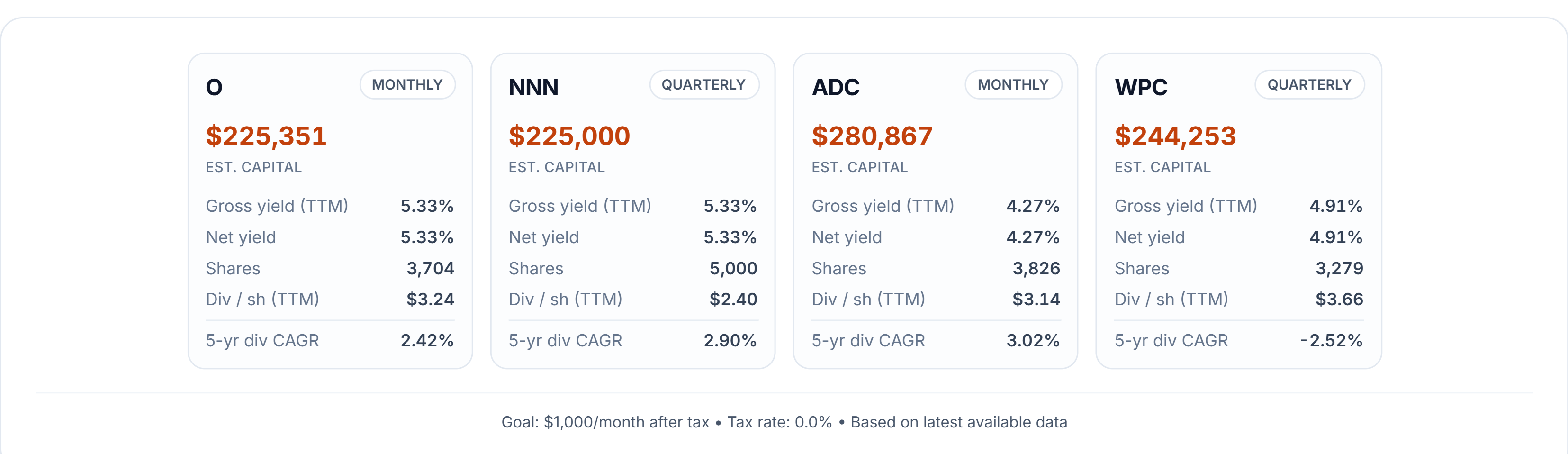
Here is a side-by-side comparison of how much capital each holding would need to produce the same monthly income goal, based on current yields and dividend income assumptions.
For a $1,000/month target, National Retail Properties (NNN) requires the least capital at approximately $225,000, supported by its yield of roughly 5.3%. At the other end of the spectrum, Agree Realty (ADC) requires approximately $280,867, reflecting its lower current yield of about 4.3%.
Realty Income (O) and W. P. Carey (WPC) sit between those two extremes, offering a balance between current income and dividend growth potential. The comparison cards make the tradeoff clear: higher-yielding holdings require less capital today, while lower-yielding holdings may rely more heavily on future dividend growth to improve income efficiency.
Yield Catch-Up Timeline
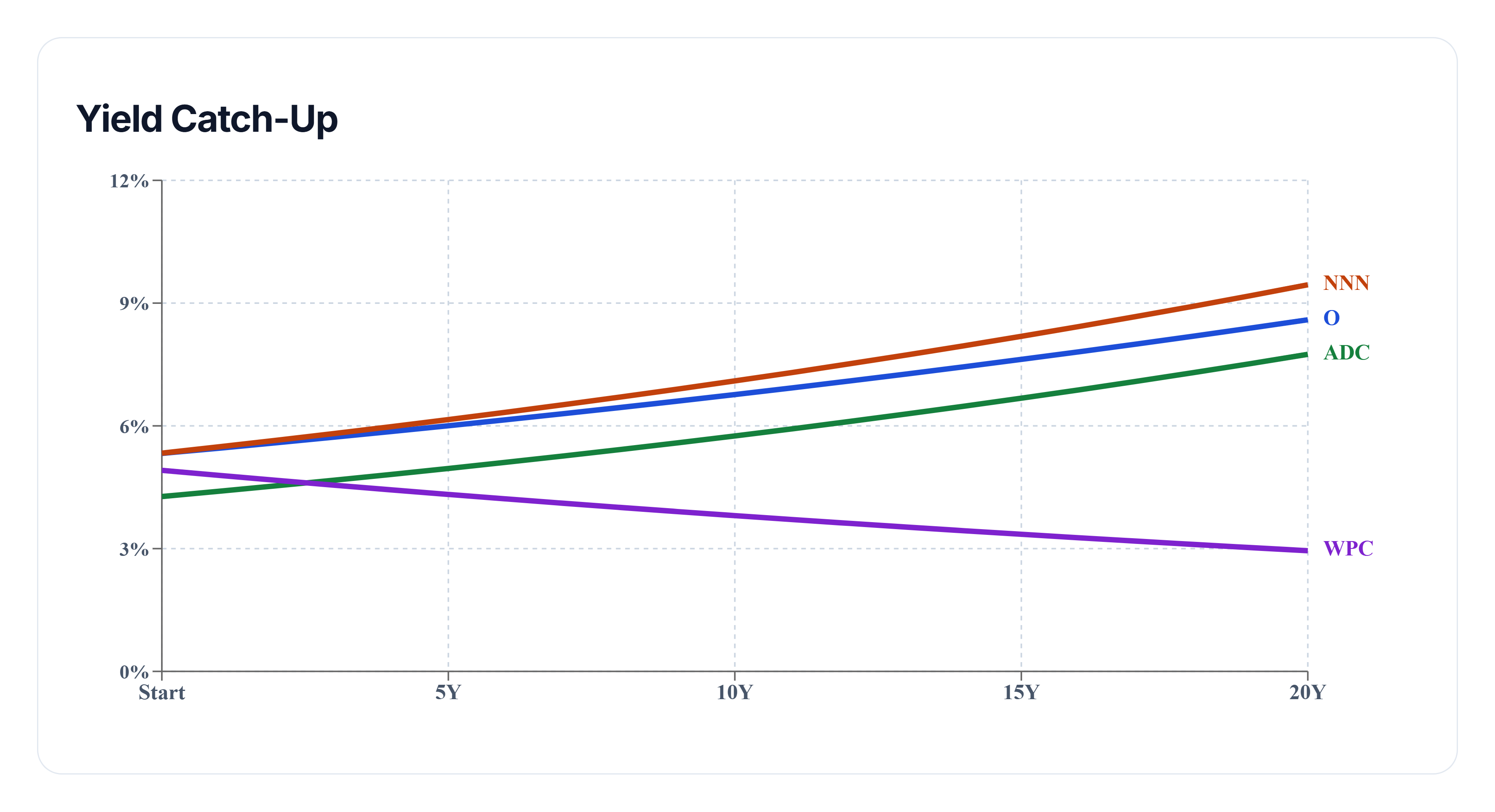
This chart shows how long it may take for a lower-yield dividend grower to match the income efficiency of a higher-yield alternative, measured by yield on cost.
The projection assumes future dividend growth continues at a pace similar to each holding's historical five-year dividend growth rate. ADC shows the strongest modeled dividend growth at roughly 3.0% annually, while NNN begins with the highest starting yield at approximately 5.3%.
Despite ADC's stronger projected growth rate, its lower starting yield creates a large gap to overcome. Even across a 20-year projection period, ADC does not fully catch NNN's projected yield-on-cost advantage. The timeline highlights an important income-investing lesson: stronger dividend growth does not always compensate for a significantly lower starting yield.
Final Takeaway
There is no universal answer to which REIT is best for generating $1,000 per month in dividend income. The right choice depends on whether you prioritize requiring less capital today, higher current income, or potentially faster dividend growth.
NNN stands out for income efficiency today thanks to its higher yield, while ADC offers the strongest projected dividend growth. Realty Income and W. P. Carey occupy the middle ground, balancing current yield with future income potential.
Use the comparison cards to evaluate how much capital is required today, and use the catch-up timeline to determine whether a lower-yielding REIT's dividend growth is likely to overcome its initial income disadvantage.