Midstream Dividend Battle: EPD vs MPLX vs ET vs WMB
Portfolio Overview
In this DividendXray battle, we compare four of the largest publicly traded midstream energy companies across dividend growth, yield-on-cost expansion, price performance, and future income potential.
- Enterprise Products Partners (EPD) operates one of North America's largest diversified pipeline and storage networks, with a long history of stable cash distributions.
- MPLX owns a broad portfolio of energy infrastructure assets and emphasizes strong cash flow generation alongside consistent distribution growth.
- Energy Transfer (ET) manages one of the largest integrated midstream systems in the United States, spanning pipelines, terminals, and storage facilities.
- The Williams Companies (WMB) focuses primarily on natural gas infrastructure and has benefited from increasing demand for natural gas transportation.
Although all four companies operate within the same industry, they balance current income, dividend growth, and capital appreciation differently.
Category Winners
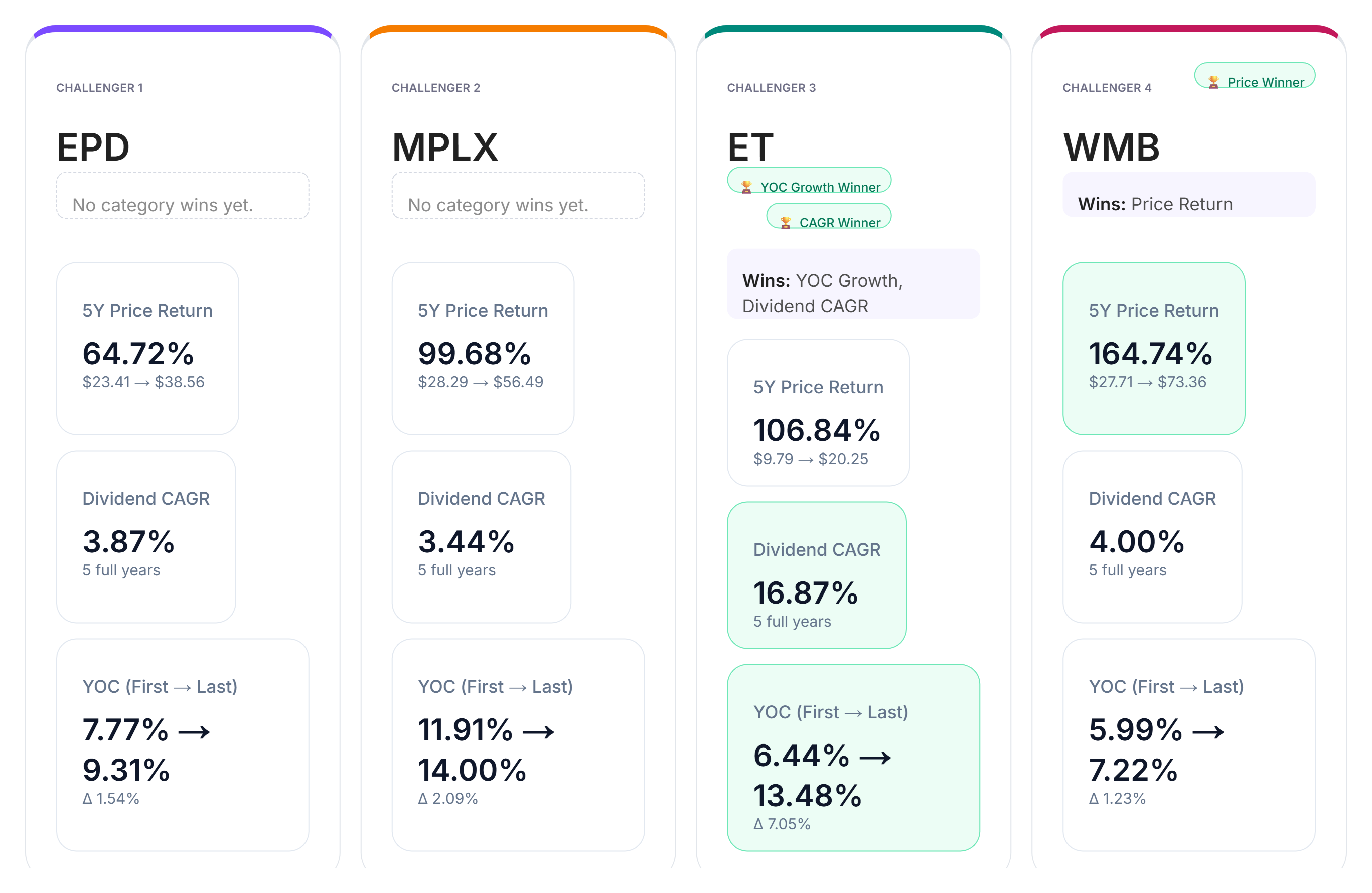
Looking across dividend growth, yield-on-cost growth, and price performance, several clear leaders emerge.
In dividend growth, ET leads the group with an impressive five-year dividend CAGR of 16.87%.
For yield-on-cost growth, ET again delivers the strongest improvement from the beginning to the end of the five-year period, reflecting rapid income expansion relative to the original investment.
In price return, WMB finishes well ahead of the group with a remarkable 164.74% gain over the same period.
EPD and MPLX produce consistently strong overall results but do not capture an individual category win in this comparison. The results illustrate how different midstream strategies can reward investors through either faster income growth or stronger capital appreciation.
Yield-on-Cost by Year
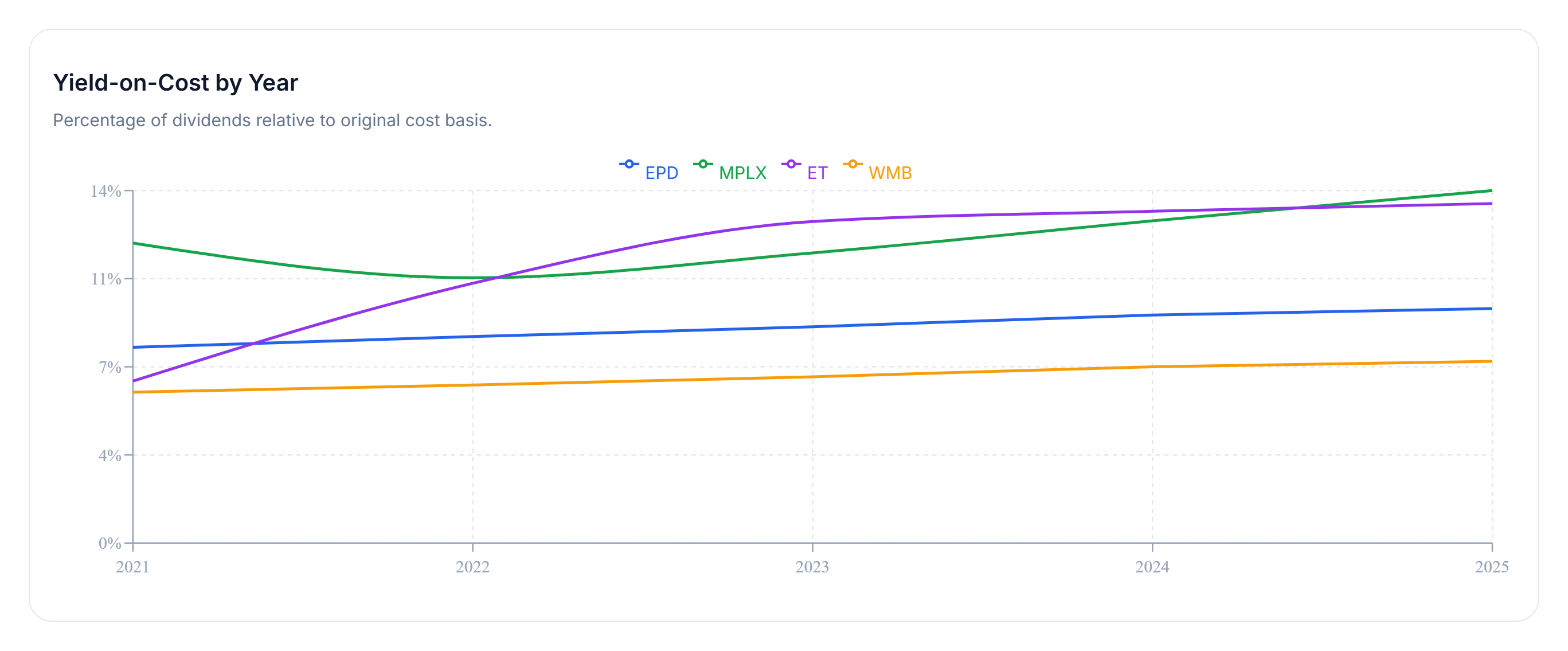
Yield on cost measures dividend income relative to the original purchase price rather than the current market value. It highlights how effectively an investment grows income over time.
Among the four companies, MPLX delivers the highest income efficiency by the end of the five-year period, reaching approximately 14.00% yield on cost.
EPD, ET, and WMB also demonstrate steadily increasing income throughout the period, although their growth paths differ. While annual changes may appear modest, the cumulative effect of consistent distribution increases becomes increasingly meaningful over longer investment horizons.
For dividend-focused investors, yield-on-cost provides another perspective on how growing distributions can improve long-term income generation.
Now let's shift from historical performance to today's income picture.
Income Goal Comparison
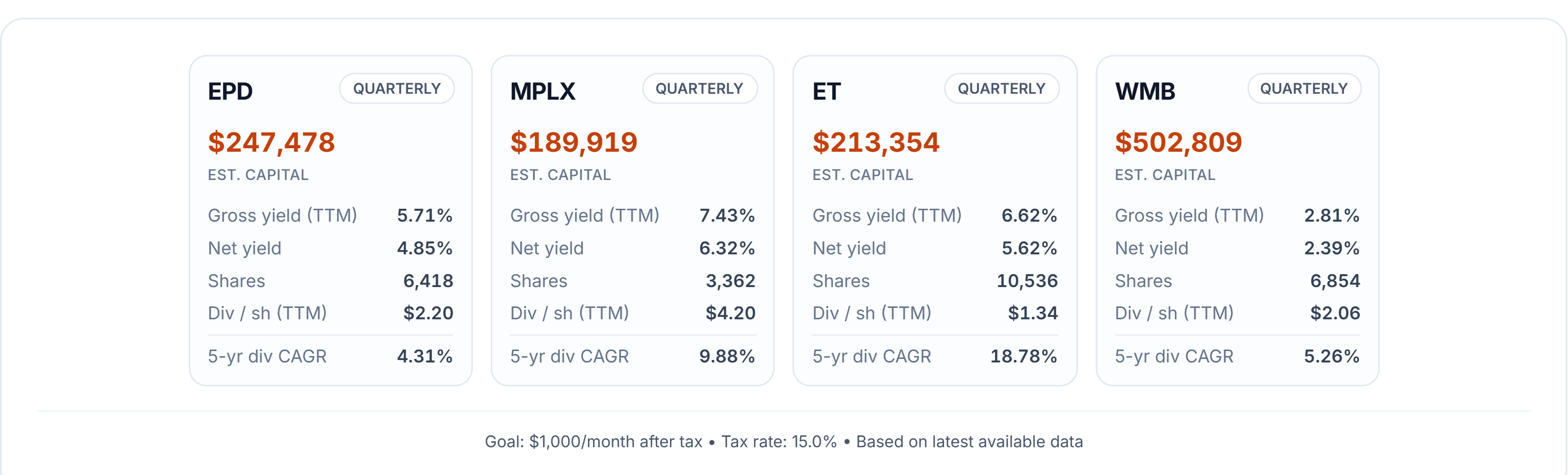
Historical performance tells only part of the story. Investors building an income portfolio also need to understand how much capital is required to generate a specific level of cash flow today.
Assuming a target of $1,000 per month after tax and a 15% dividend tax rate, MPLX requires the least capital at approximately $189,919, supported by its current yield of roughly 7.4%.
At the opposite end of the comparison, WMB requires approximately $502,809 because of its lower current yield of about 2.8%.
EPD and ET fall between those two extremes, offering a balance between attractive current income and strong long-term dividend growth.
The comparison highlights an important tradeoff: higher-yield investments generally require less capital today, while lower-yield companies may rely more heavily on future dividend growth to improve long-term income efficiency.
Yield Catch-Up Timeline
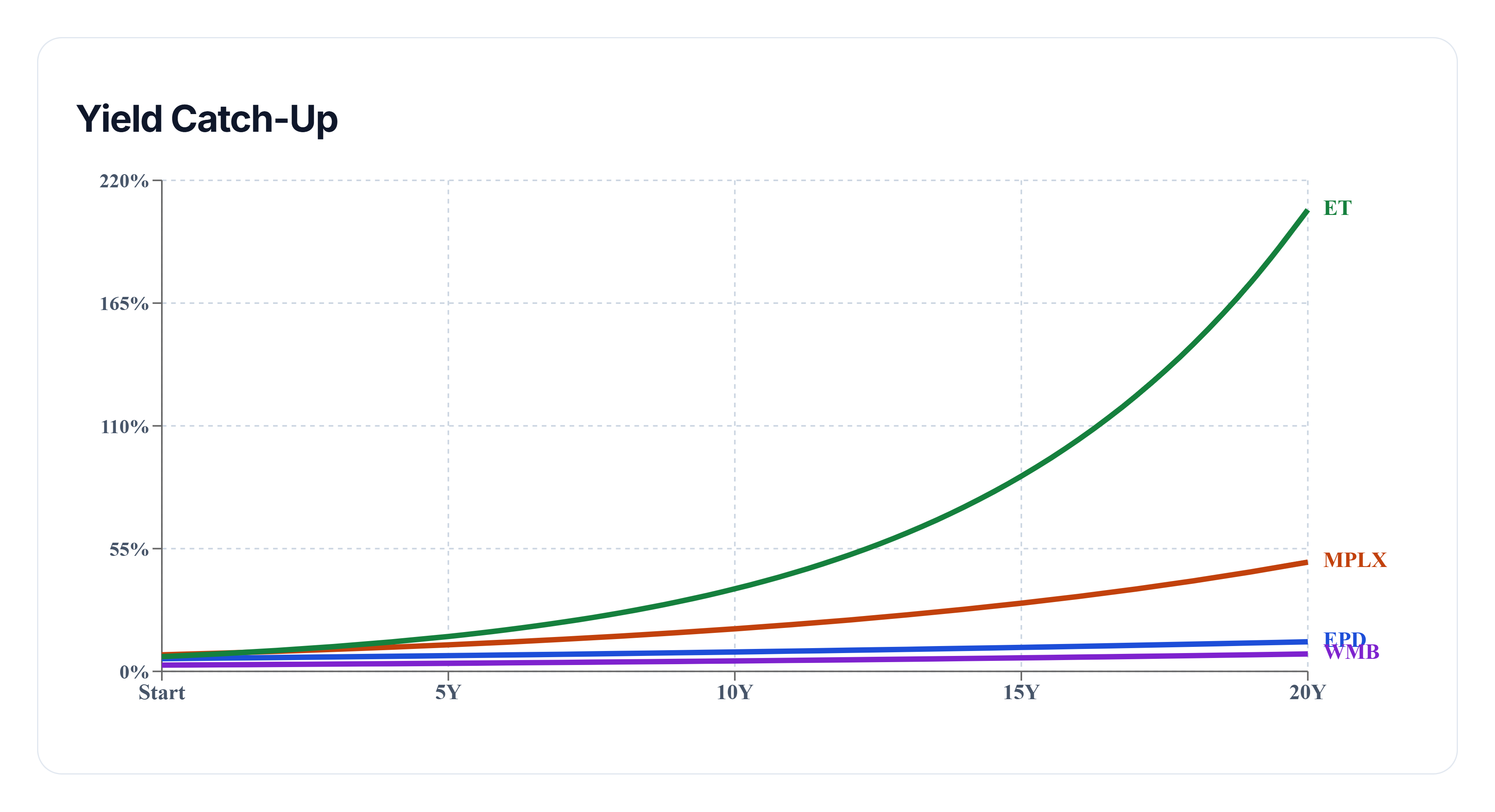
The final comparison projects future yield on cost by assuming dividend growth continues at a pace similar to each company's historical five-year average.
ET posts the strongest projected dividend growth rate at approximately 16.8%, while MPLX begins with the highest current yield at around 7.4%.
WMB starts from a much lower yield of approximately 2.8%. Even after twenty years of projected dividend growth, it still does not catch MPLX in projected yield on cost.
The timeline illustrates that a rapidly growing dividend can narrow the gap over time, but a substantial starting yield advantage remains difficult to overcome. Both current yield and dividend growth play important roles when evaluating long-term income potential.
Final Takeaway
Each of these midstream companies offers a different mix of current income, dividend growth, and long-term return potential.
ET stands out for its exceptional dividend growth, while WMB delivers the strongest historical price appreciation. MPLX combines the highest current yield with the lowest capital requirement for generating $1,000 per month after-tax income, making it the most efficient income producer in today's comparison. EPD provides a balanced profile with competitive income characteristics across multiple categories.
Rather than identifying a single "best" investment, this comparison demonstrates the tradeoffs between maximizing income today, accelerating future dividend growth, and pursuing long-term total returns. The right choice ultimately depends on an investor's income goals, time horizon, and overall portfolio strategy.