MCD vs SBUX vs YUM vs DRI: Restaurant Dividend Stock Battle
Portfolio Overview
In this DividendXray battle, we compare four major restaurant stocks across dividend growth, yield-on-cost expansion, and price return over a ten-year period.
- MCD is the global fast-food giant, built around its massive franchise network and decades of dividend growth.
- SBUX operates one of the world's largest coffee chains, combining global expansion with a relatively young but fast-growing dividend.
- YUM owns brands including KFC, Taco Bell, and Pizza Hut, supported by a heavily franchised global business model.
- DRI, the company behind Olive Garden and LongHorn Steakhouse, rounds out the group with a growing restaurant portfolio and a strong dividend growth record.
Each company approaches the restaurant business differently, making this a useful comparison of how dividend growth, income efficiency, and share-price appreciation have developed over the same historical window.
Category Winners
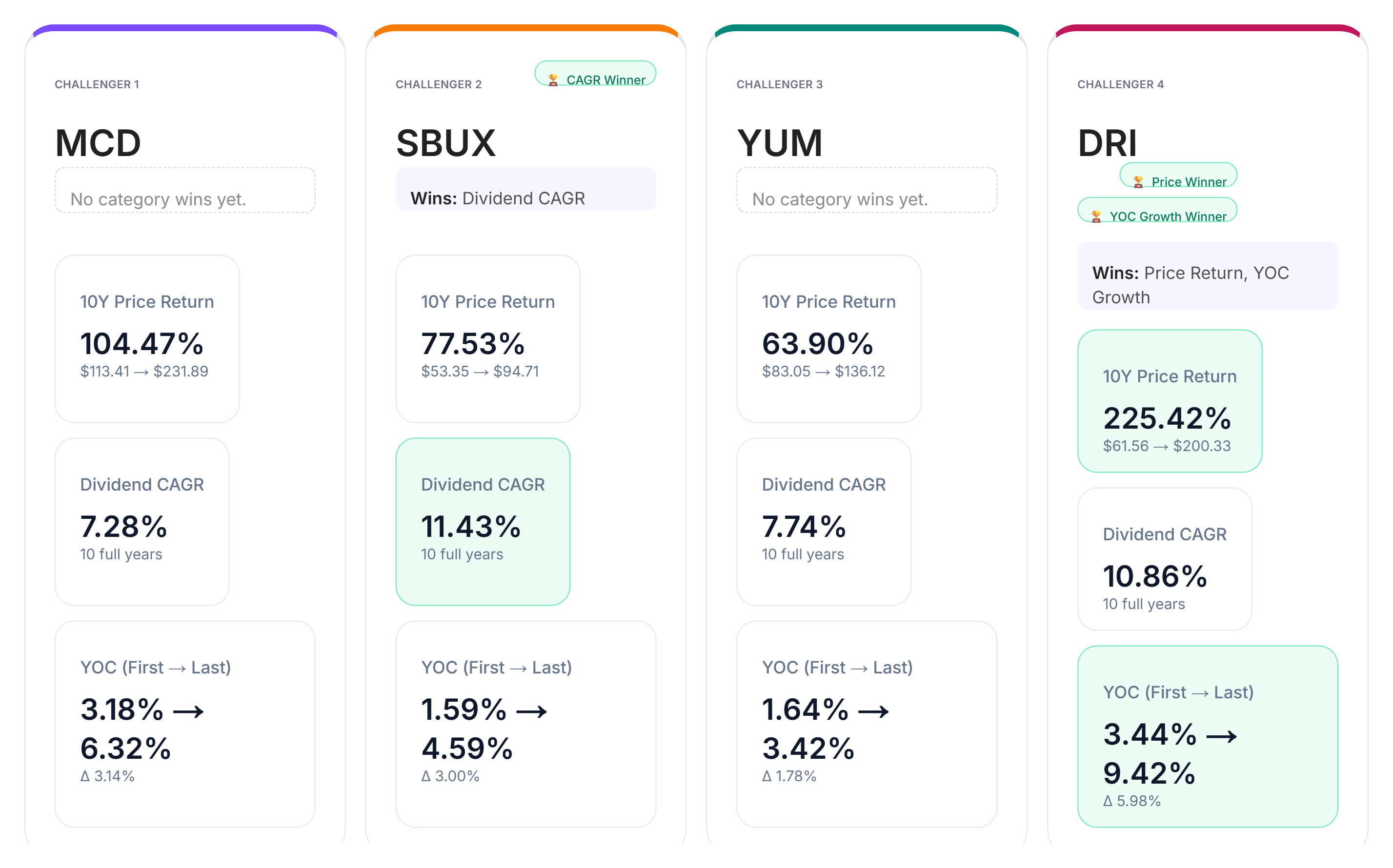
Looking across dividend CAGR, yield-on-cost growth, and price return, two stocks take the category wins.
In dividend growth, SBUX leads the group with a ten-year dividend CAGR of 11.43%.
For yield-on-cost growth, DRI shows the strongest improvement from the first year to the last, reflecting the largest increase in dividend income relative to the original investment.
In price return, DRI takes another category win with a ten-year return of 225.42%.
MCD and YUM both deliver solid results across the comparison, but neither takes a category win in this battle. The results also show why looking at several metrics together can reveal more than focusing on dividend growth or price appreciation alone.
Yield-on-Cost by Year
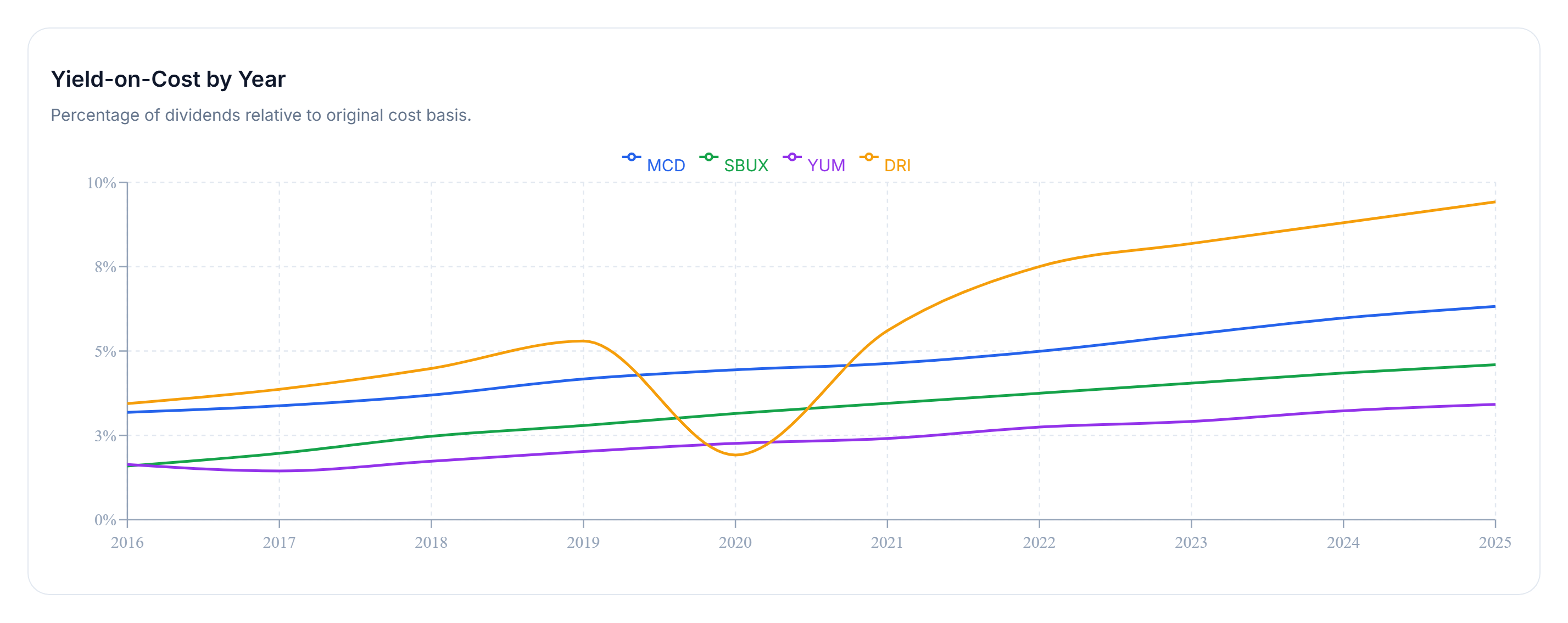
Yield on cost measures dividend income relative to the original investment rather than the stock's current market price. It provides a way to see how the income generated by the original capital changes over time.
Across the ten-year window, DRI stands out with the strongest income efficiency, reaching approximately 9.42% yield on cost by the end of the period.
There is an important detail within Darden's historical record. The company suspended its quarterly dividend during the COVID-19 disruption in 2020. The two missing quarterly payments during that year are intentional and are not missing market data.
Despite that interruption, DRI finishes the period with the highest yield on cost. MCD, SBUX, and YUM follow more gradual upward income trajectories over the same ten-year window.
The historical comparison shows what actually happened to income and price performance over the period. But an investor building income today faces a different question: how much capital would each stock require right now to reach the same income target?
Now let's shift from past performance to today's income picture.
Income Goal Comparison
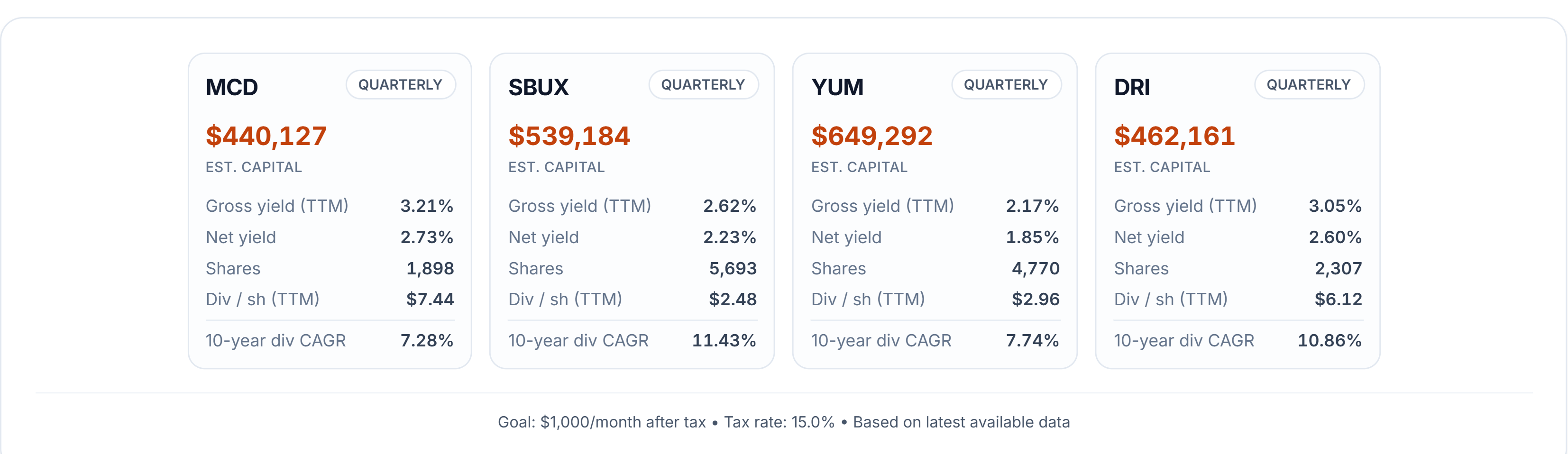
How much capital would it take to generate $1,000 per month in after-tax dividend income from each restaurant stock today?
Using a 15% tax assumption, MCD requires the least capital in this comparison at roughly $440,127, supported by a current yield near 3.2%.
At the other end of the comparison, YUM requires the most capital at approximately $649,292, with a current yield near 2.2%.
SBUX and DRI fall between those two extremes.
The comparison highlights the importance of starting yield when the objective is immediate income. A higher yield means less capital is required to generate the same amount of dividend income today.
But today's yield is only one part of the equation. Dividend growth can change how much income the original investment generates over time, which brings us to the final phase of the comparison.
Yield Catch-Up Timeline
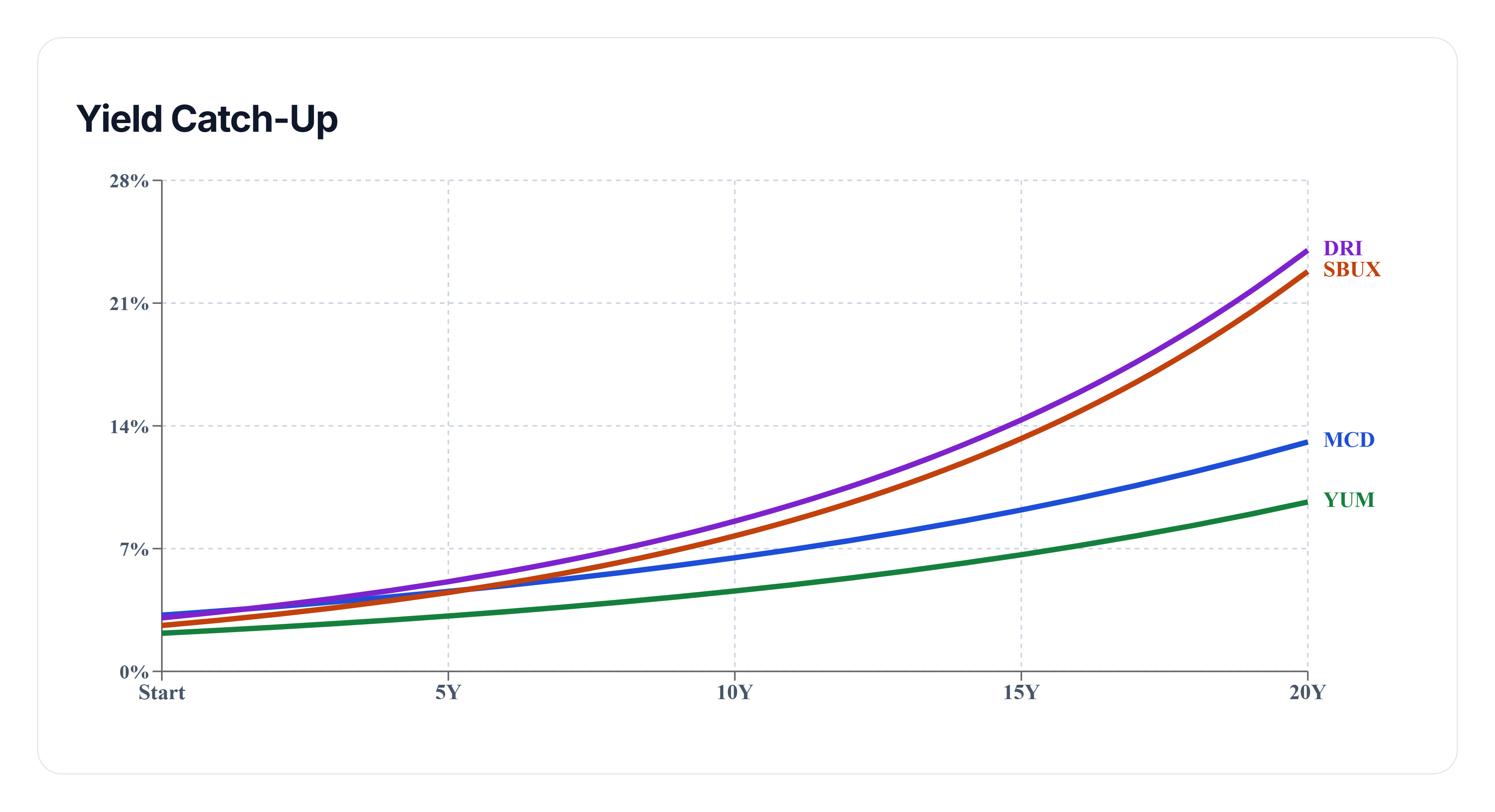
The catch-up projection looks forward by assuming that future dividend growth continues at a pace similar to each company's historical ten-year dividend CAGR.
SBUX enters the projection with the strongest historical dividend growth rate at approximately 11.4%, while MCD begins with the highest current yield at roughly 3.2%. YUM starts near 2.2%.
This creates a trade-off between starting income and subsequent dividend growth. A stock beginning with a lower yield has more ground to make up, even if its dividend grows at a faster rate.
The projection illustrates how those differences could affect yield on cost over a much longer holding period. Not every gap necessarily closes quickly: even after projecting the historical growth rates forward for 20 years, YUM still does not catch MCD on yield on cost.
These projections are not forecasts of what the companies will actually pay. They illustrate what would happen if dividend growth continued at rates similar to those observed over the historical ten-year period.
Final Takeaway
This restaurant stock battle produces different winners depending on what is being measured.
SBUX leads the group in historical dividend growth with a 10-year CAGR of 11.43%, while DRI delivers the strongest yield-on-cost improvement and the highest 10-year price return at 225.42%. DRI also finishes the historical period with yield on cost of approximately 9.42%.
When the comparison shifts to generating income today, MCD has the advantage of the highest starting yield in the group at roughly 3.2%, requiring approximately $440,127 to produce the $1,000 monthly after-tax target. YUM, at roughly 2.2%, requires about $649,292.
The final projection connects the two sides of the analysis. Starting yield determines how much income an investment generates today, while dividend growth influences how that income may evolve relative to the original investment.
Together, the three phases — historical performance, present income potential, and projected yield-on-cost growth — provide a more complete picture than any one metric viewed on its own.