MAIN vs ARCC vs HTGC vs CSWC: Which BDC Delivers the Best Dividend Income?
Portfolio Overview
In this DividendXray battle, we compare four well-known business development companies (BDCs) across dividend growth, yield-on-cost expansion, price performance, and income generation.
- MAIN is known for its long history of monthly dividends and its focus on lower middle-market businesses.
- ARCC is one of the largest BDCs, combining broad diversification with a strong income track record.
- HTGC specializes in venture-backed technology and life sciences companies, providing investors with higher income potential.
- CSWC focuses on lower middle-market investments while maintaining a disciplined dividend strategy.
Although all four companies operate within the BDC sector, each follows a different approach to balancing dividend yield, portfolio composition, and long-term shareholder returns.
Category Winners
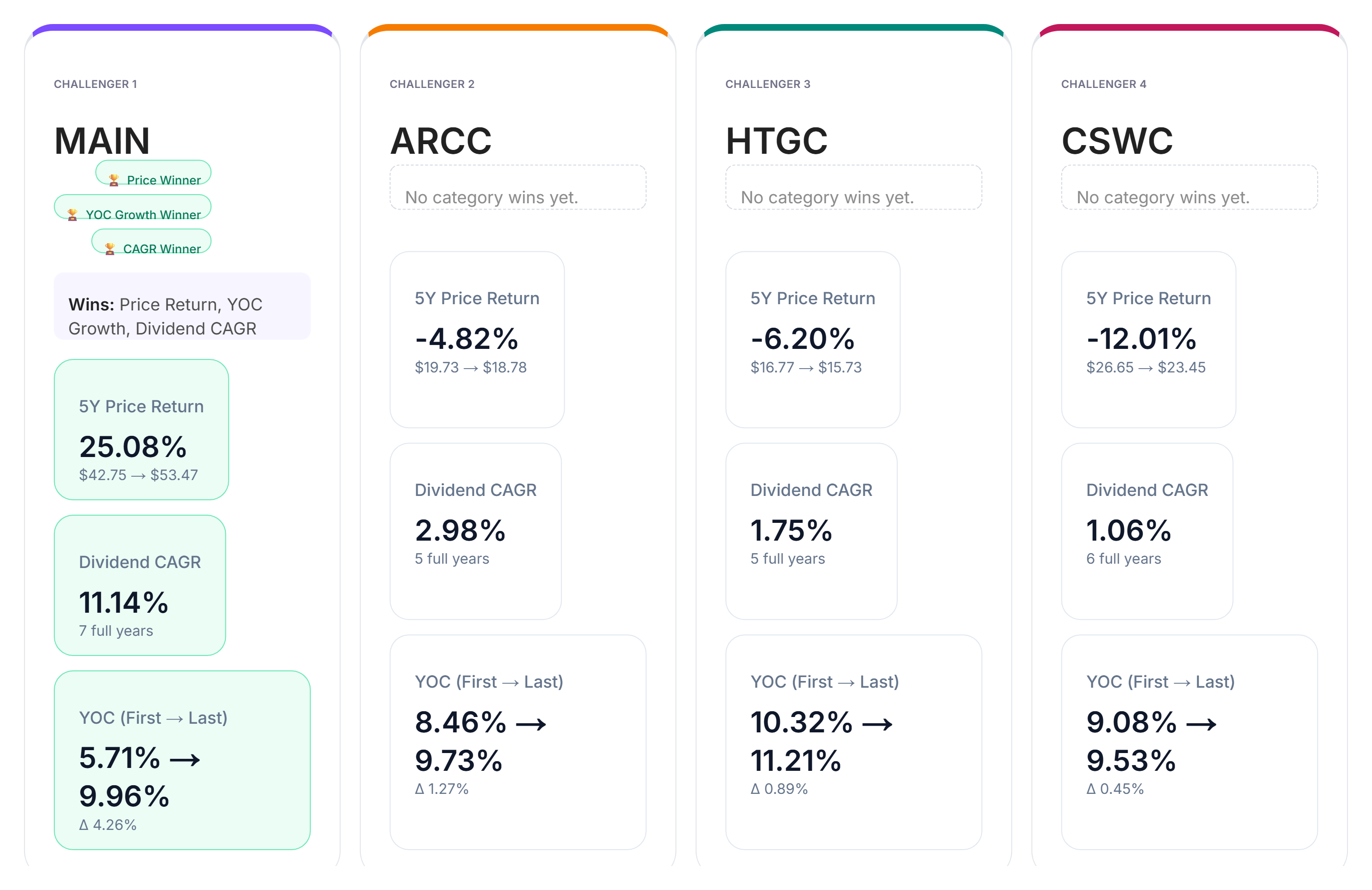
Looking across dividend CAGR, yield-on-cost growth, and five-year price return, one company clearly separates itself in this comparison.
In dividend growth, MAIN leads the group with a five-year dividend CAGR of 11.14%.
For yield-on-cost growth, MAIN again delivers the strongest improvement from the beginning to the end of the five-year period, reflecting exceptional dividend compounding.
In price return, MAIN also finishes first with a five-year gain of 25.08%.
ARCC, HTGC, and CSWC each produce solid historical results, but none secure a category win in this particular battle. The comparison highlights how consistent dividend growth can positively influence both income expansion and long-term total return.
Yield-on-Cost by Year
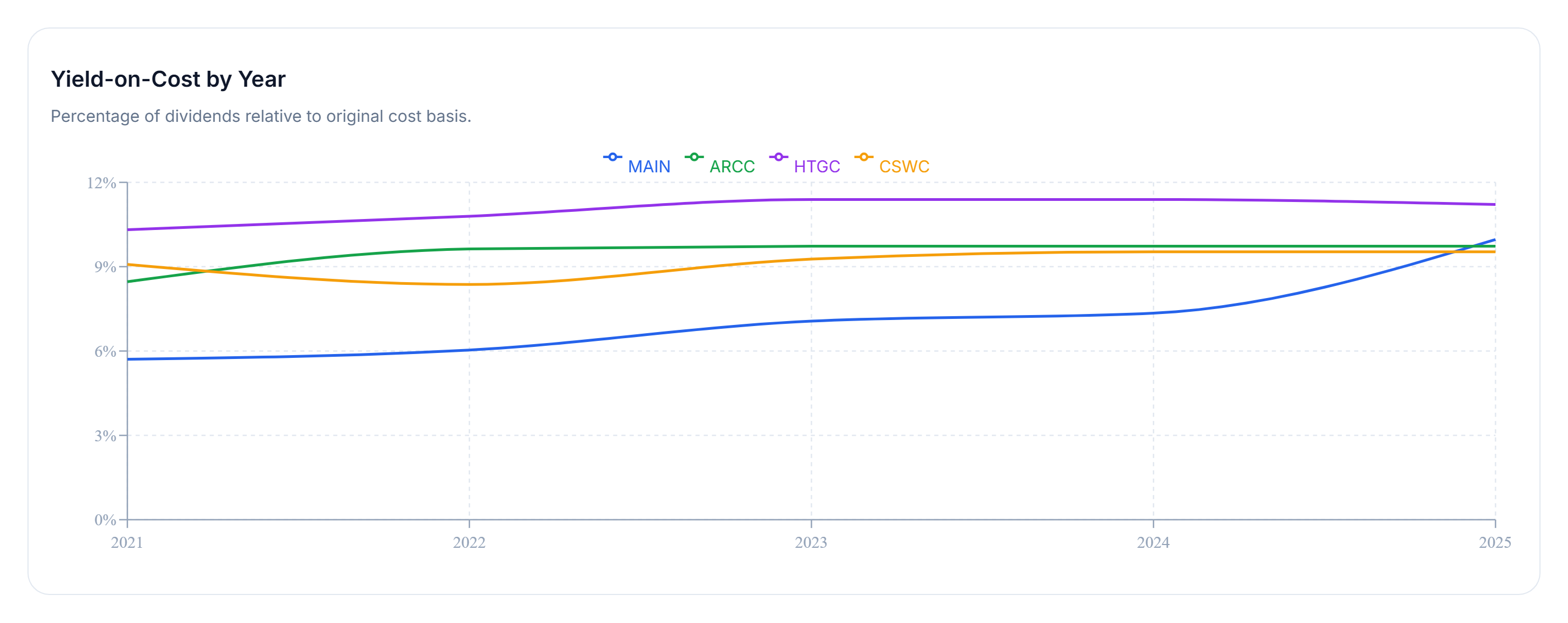
Yield-on-cost measures annual dividend income relative to the original purchase price rather than the stock's current market value. It provides a useful way to visualize how income compounds over time.
Over the five-year period, HTGC produces the highest ending yield on cost, reaching approximately 11.21%.
MAIN, ARCC, and CSWC also display steady increases in dividend income over time, although their trajectories are more gradual. The differences become increasingly noticeable as dividends compound year after year.
For long-term income investors, yield-on-cost helps illustrate which holdings have historically generated the greatest income growth from the same initial investment.
Now let's shift from historical performance to today's income picture.
Income Goal Comparison
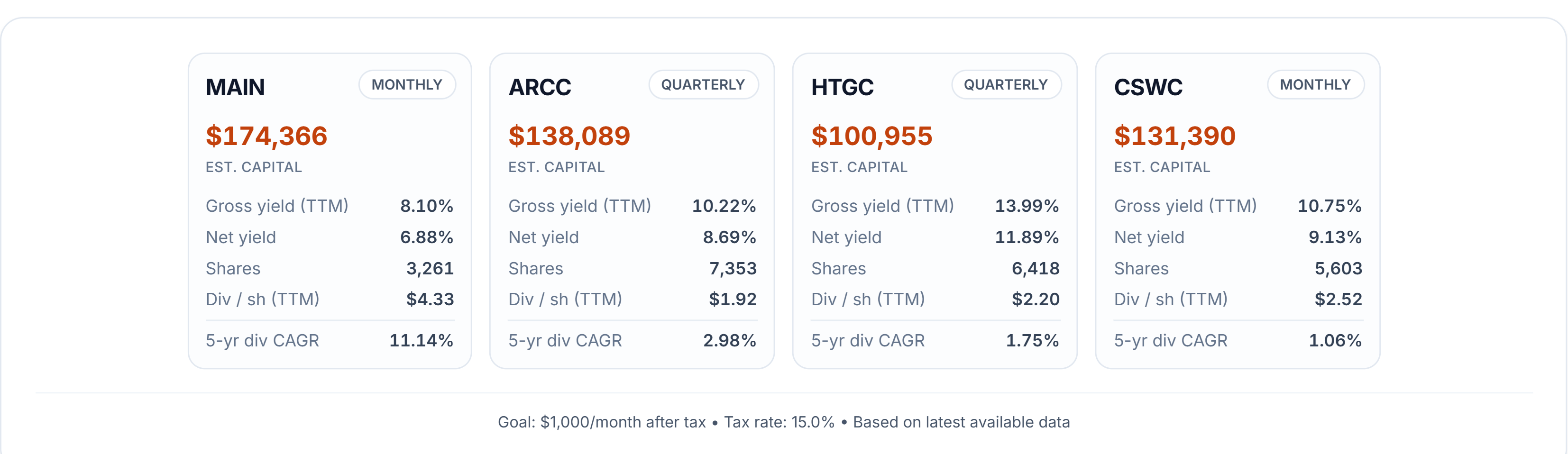
How much capital is required to generate $1,000 per month after taxes? The answer depends largely on each company's current dividend yield.
Using a 15% dividend tax assumption, HTGC requires the least starting capital at approximately $100,955, supported by its dividend yield of roughly 14.0%.
At the opposite end, MAIN requires approximately $174,366, reflecting its lower current yield of around 8.1% despite its stronger historical dividend growth.
ARCC and CSWC fall between those two extremes, offering a balance between current income and dividend growth characteristics.
The comparison illustrates one of the most important trade-offs in dividend investing: higher-yield securities generally require less capital today, while lower-yield companies with stronger dividend growth may become increasingly competitive over longer holding periods.
Yield Catch-Up Timeline
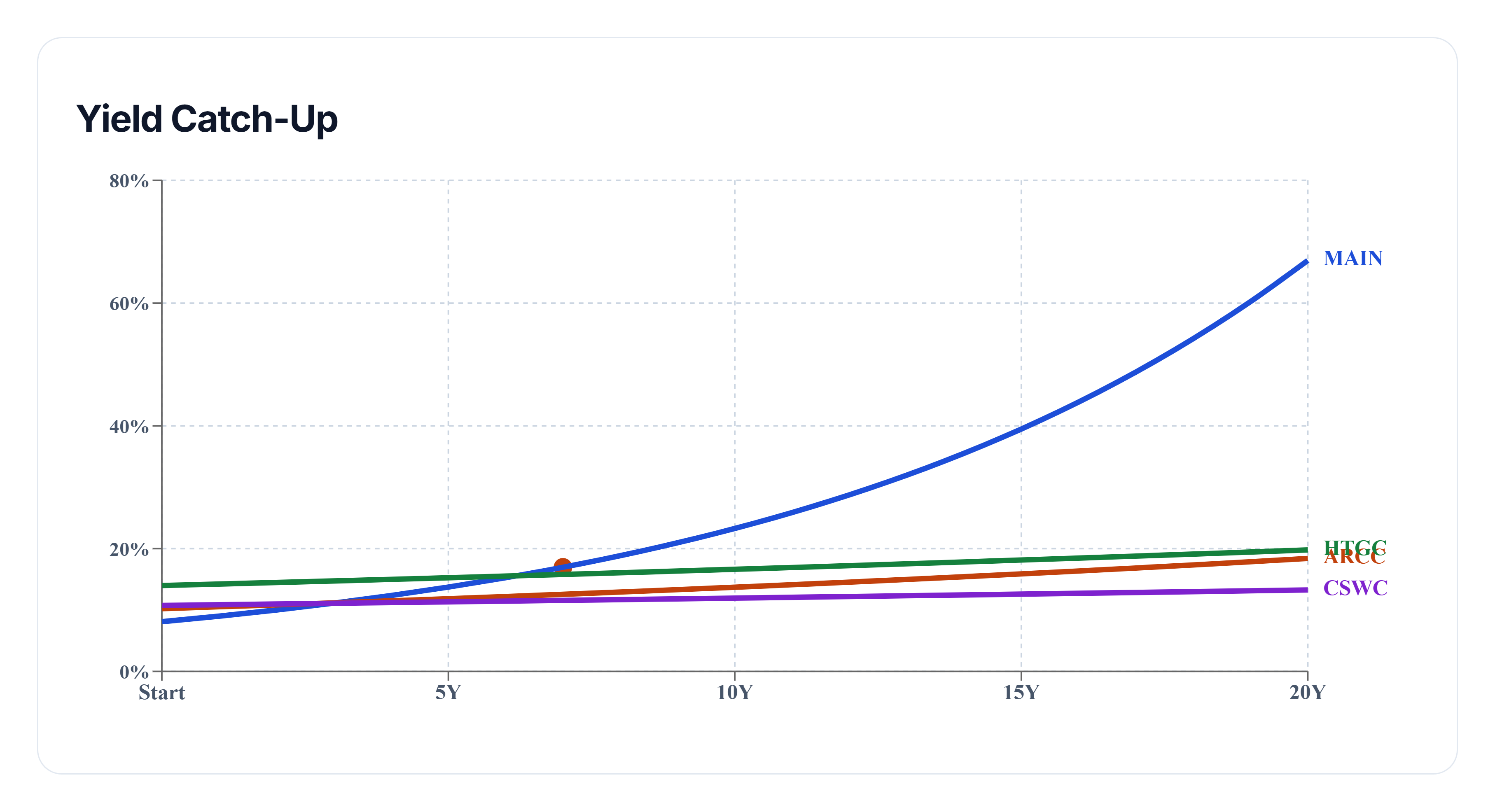
This projection assumes future dividend growth continues at a pace similar to each company's historical five-year dividend CAGR.
HTGC begins with the highest current yield at approximately 14.0%, giving it the strongest starting income advantage.
MAIN starts with the lowest current yield at roughly 8.1%, but also delivers the fastest modeled dividend growth at approximately 11.1% annually.
Under these assumptions, MAIN gradually closes the income gap and is projected to overtake HTGC at approximately year seven, producing the higher projected yield on cost thereafter.
The timeline demonstrates how a faster dividend growth rate can eventually offset a lower initial yield, although the crossover requires patience and years of compounding.
Final Takeaway
There is no universally superior business development company. Each holding represents a different balance between current income and future dividend growth.
This comparison shows MAIN dominating the historical performance categories while HTGC provides the strongest current income efficiency and requires the least capital to reach a fixed monthly income goal today.
When future dividend growth is incorporated into the analysis, MAIN's higher growth rate is projected to eventually overcome HTGC's initial yield advantage after roughly seven years.
For dividend investors, the decision ultimately comes down to investment objectives: maximizing income today, maximizing future income growth, or balancing both within a diversified dividend portfolio.