Global Energy Dividend Battle: Exxon vs Chevron vs Shell vs BP

Portfolio Overview
In this DividendXray battle, we compare four major global energy companies across dividend growth, yield-on-cost expansion, and total return over a five-year period.
- Exxon Mobil (XOM) emphasizes scale, integrated operations, and long-term dividend stability across global energy markets.
- Chevron (CVX) combines strong upstream production with disciplined capital allocation and a long history of dividend growth.
- Shell (SHEL) delivers higher income supported by global energy trading, diversified operations, and strong dividend expansion.
- BP (BP) offers a higher-yield profile with exposure to both traditional oil and gas production and evolving energy transition investments.
Each company operates within the same sector but approaches capital allocation, income generation, and long-term strategy slightly differently.
Category Winners
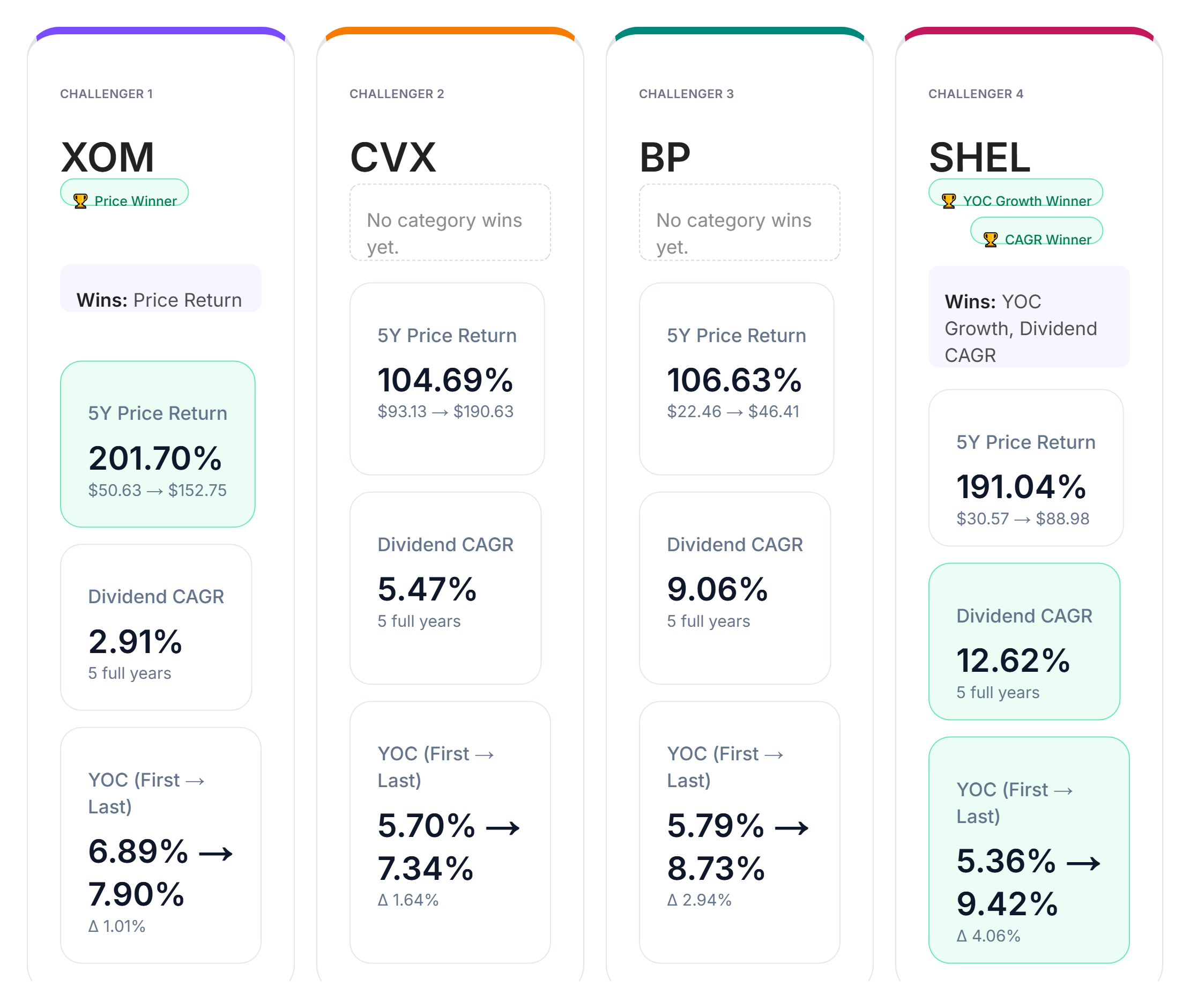
Looking at the data across dividend CAGR, yield-on-cost growth, and price return, clear category leaders emerge.
In dividend growth, SHEL leads the group with a five-year dividend CAGR of 12.62%.
For yield-on-cost growth, SHEL again shows the strongest improvement from first to last year, reflecting the most efficient income compounding relative to the original investment.
In price return, however, XOM takes the lead with a five-year return of 201.70%, delivering the strongest overall appreciation among the group.
CVX and BP deliver solid results across the comparison period, but do not secure a category win in this battle. The outcome highlights how different capital strategies within the energy sector can influence income growth and total return.
Yield-on-Cost by Year
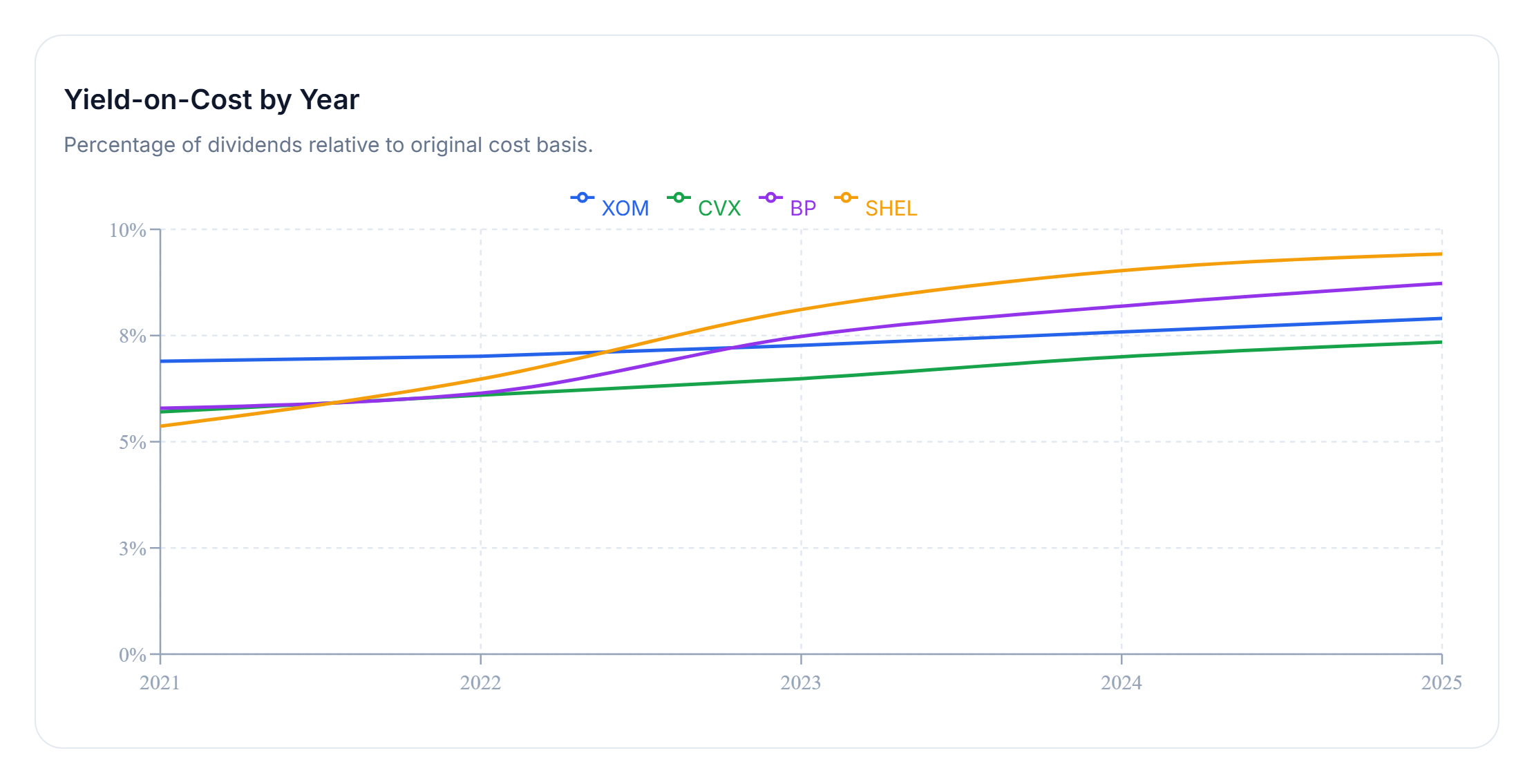
Yield-on-cost measures dividend income relative to the original capital invested. Unlike current yield, it focuses on how efficiently a holding grows income over time.
Over the five-year window, SHEL stands out with the strongest income efficiency, reaching approximately 9.42% yield on cost by the end of the period.
XOM, CVX, and BP also demonstrate steady upward income trends across the same timeframe. While their income growth trajectories are more gradual, each shows consistent dividend expansion supported by the underlying profitability of global energy markets.
For long-term income investors, these differences can compound meaningfully. Strong dividend growth combined with disciplined capital management can steadily increase income generation even without adding new capital.
Final Takeaway
The global energy sector contains several powerful dividend payers, but each company balances income yield, dividend growth, and capital appreciation differently.
In this battle, Shell dominates the income growth metrics, delivering the strongest dividend CAGR and yield-on-cost expansion. Exxon Mobil stands out in total return performance, reflecting strong market appreciation over the same five-year period.
Chevron and BP continue to provide competitive income profiles and steady dividend growth, but do not take a category lead in this comparison.
For dividend-focused investors, the decision ultimately comes down to priorities — whether the goal is maximizing dividend growth efficiency, capturing strong total return, or maintaining diversified exposure within the global energy sector.