CSX vs Norfolk Southern vs UPS vs FedEx: Dividend & Income Battle

Portfolio Overview
In this DividendXray battle, we compare four major railroad, transportation, and logistics companies across dividend growth, yield-on-cost expansion, and price return performance over a five-year period.
- CSX operates one of the largest freight rail networks in the eastern United States.
- Norfolk Southern is another major freight railroad, serving markets across the eastern U.S.
- UPS is a global package delivery and logistics leader known for its strong dividend income.
- FedEx operates a worldwide transportation network spanning shipping, freight, and logistics.
These companies operate across different parts of the transportation economy, giving investors different combinations of current income, dividend growth, and historical price appreciation.
Category Winners
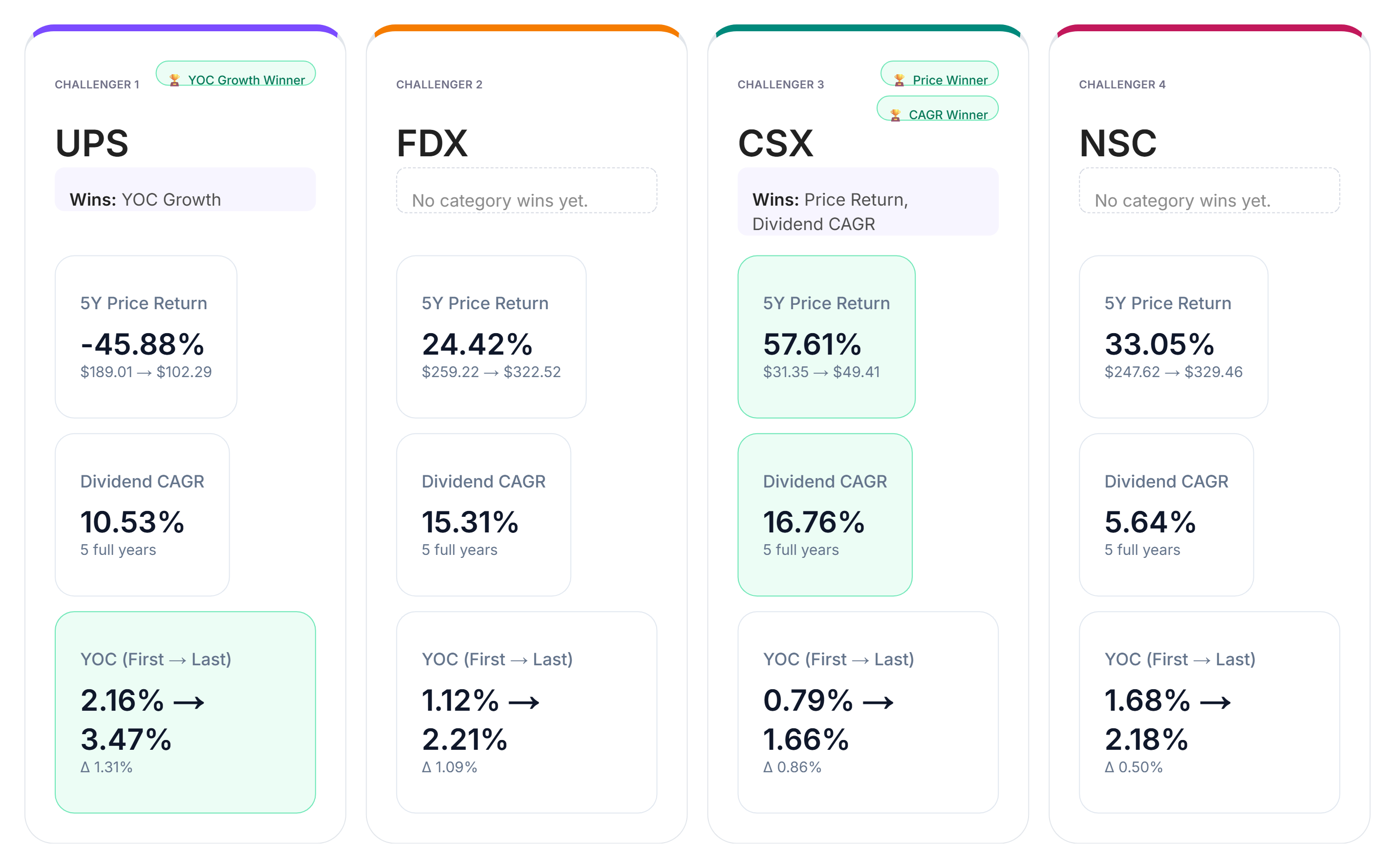
Looking at the five-year data across dividend CAGR, yield-on-cost growth, and price return, two companies emerge as category leaders.
In dividend growth, CSX leads the group with a five-year dividend CAGR of 16.76%.
For yield-on-cost growth, UPS shows the strongest improvement from the first year to the last.
In price return, CSX takes another category win, delivering a five-year return of 57.61%.
FedEx and Norfolk Southern deliver solid results across the comparison, but neither secures a category win in this battle.
The results show two different strengths at the top: CSX leads in dividend growth and historical price appreciation, while UPS stands out for the improvement in income generated relative to the original investment.
Yield-on-Cost by Year
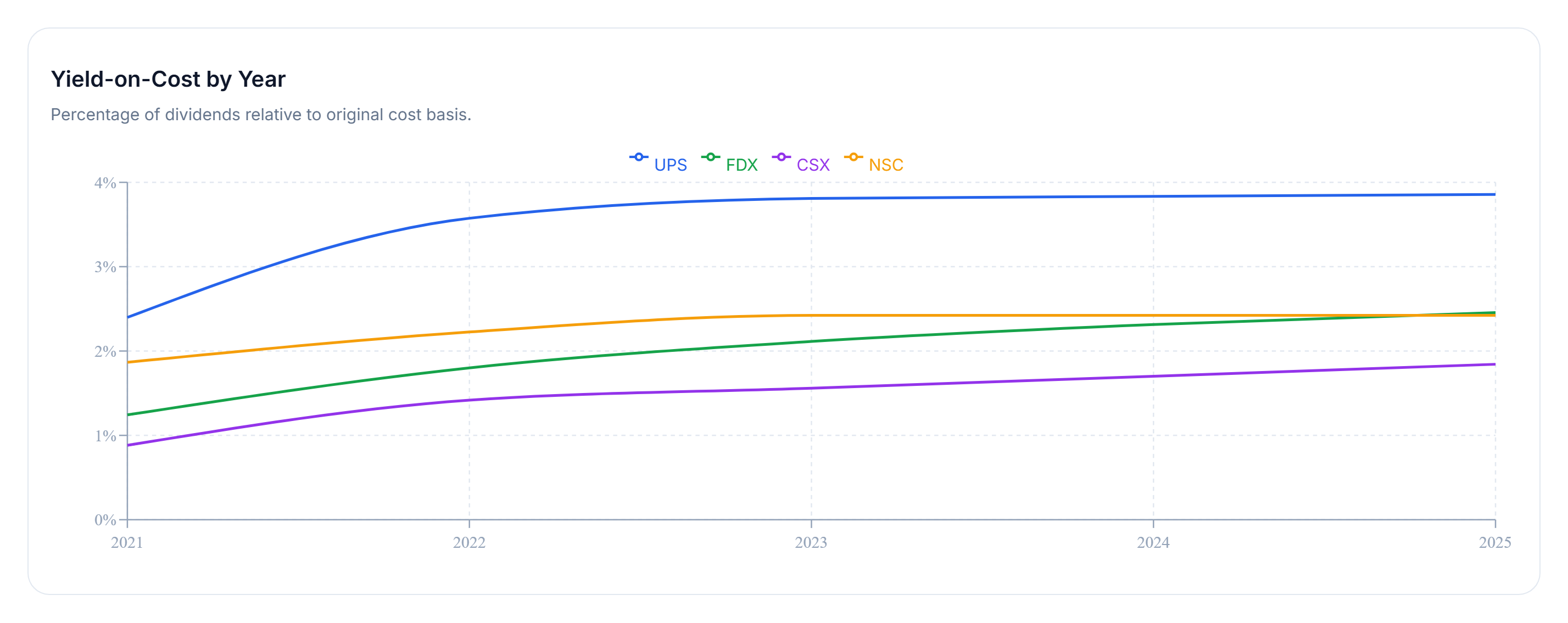
Yield on cost measures dividend income relative to the original capital invested rather than the current market price. It helps show how effectively a holding has grown income on the investor's original cost basis.
Across the five-year period, UPS stands out with the strongest income efficiency, reaching approximately 3.47% yield on cost by the end of the period.
That gives UPS the strongest improvement from the first year to the last among the four companies.
CSX, meanwhile, leads the battle in dividend CAGR, demonstrating that the company with the fastest dividend growth does not necessarily finish with the highest yield on cost over a specific historical window.
For income-focused investors, that distinction matters. Starting yield and dividend growth both influence how much income an investment ultimately generates relative to the original capital invested.
Now let's shift from past performance to today's income picture.
Income Goal Comparison
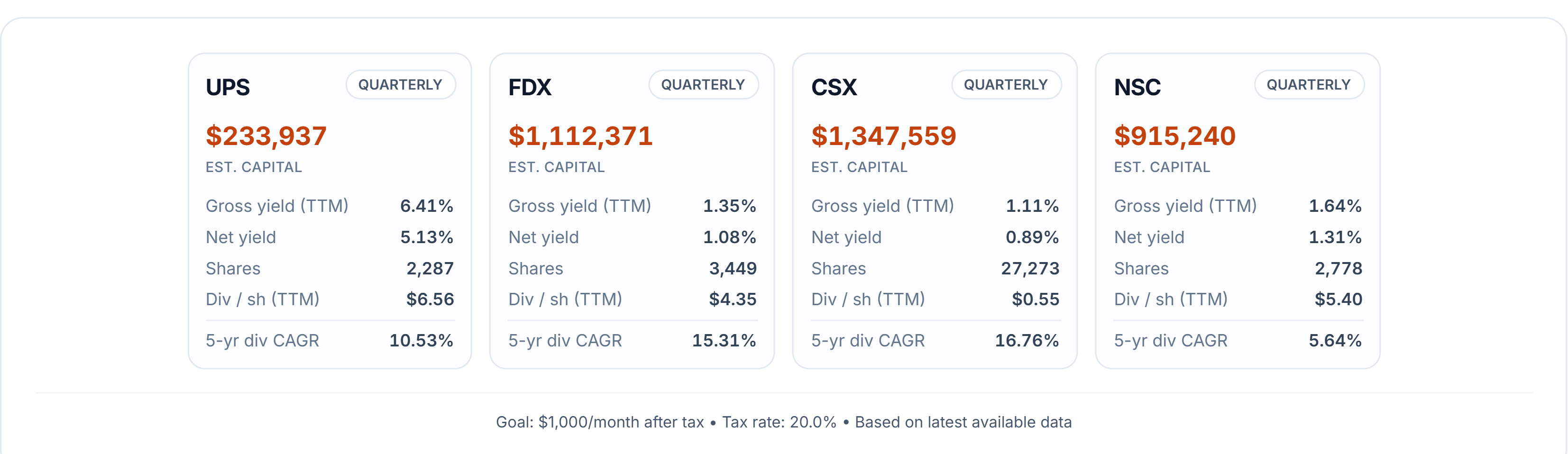
How much capital would each company require to generate $1,000 per month in after-tax dividend income today?
Using a 20% tax rate, the differences are substantial.
UPS requires the least capital at roughly $234,000, supported by a current yield near 6.4%.
At the opposite end of the comparison, CSX requires approximately $1.35 million to generate the same after-tax monthly income, with a current yield near 1.1%.
That gives UPS the strongest starting income position, while CSX begins with the lowest yield.
FedEx and Norfolk Southern sit more in the middle, offering a different balance between current yield and dividend growth.
This creates the central tradeoff in the income comparison. A higher starting yield can dramatically reduce the amount of capital required to generate a given level of income today, while faster dividend growth may improve income efficiency over time.
That raises the next question: can CSX's much faster dividend growth eventually overcome UPS's large starting-yield advantage?
Yield Catch-Up Timeline
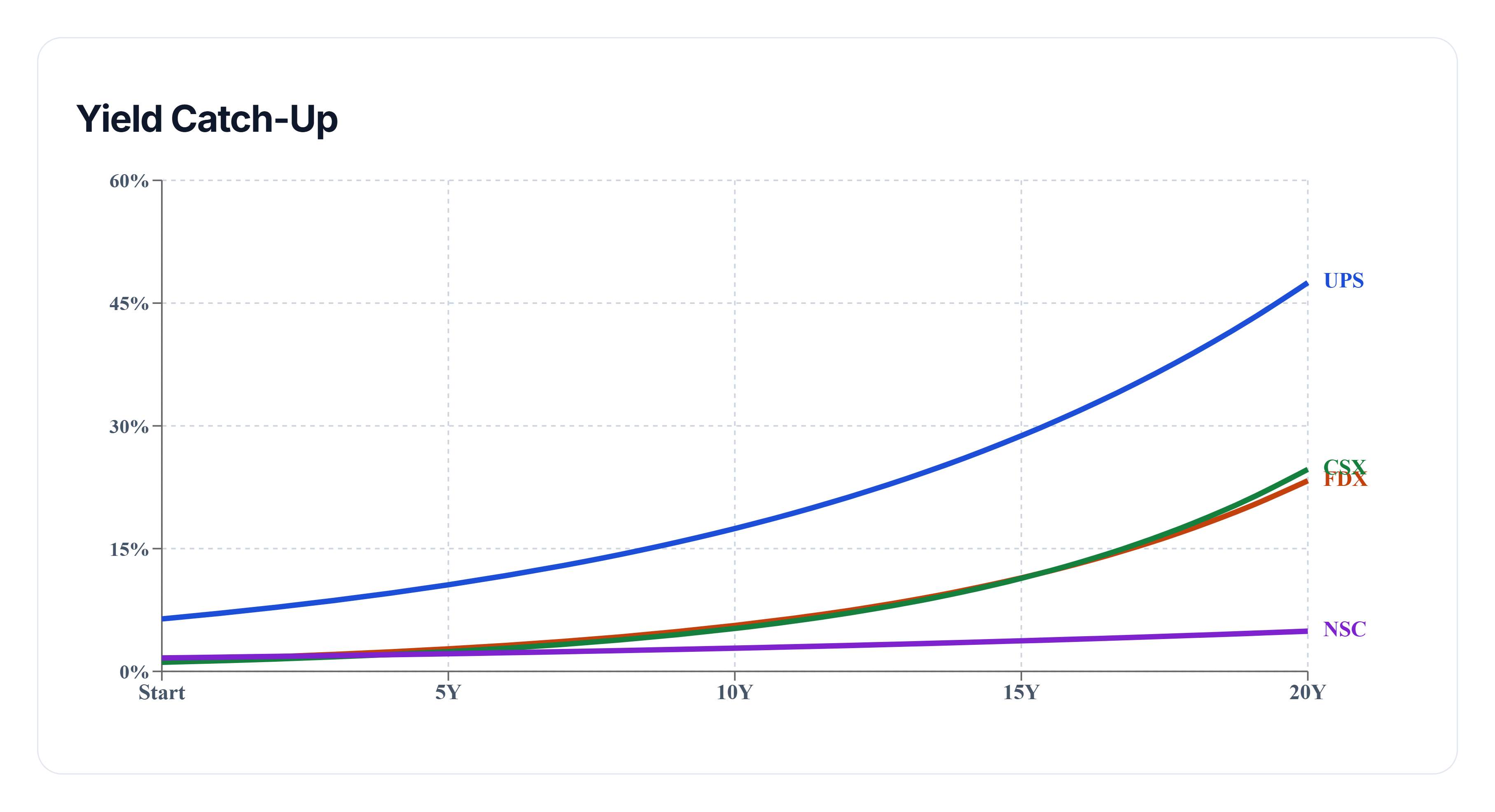
The catch-up projection models how yield on cost could evolve if future dividend growth continues at roughly the same pace as it did over the past five years.
This is a projection based on historical growth rates, not a prediction that those growth rates will continue.
CSX enters the model with the strongest dividend growth rate, at nearly 16.8%, but starts with a yield of only about 1.1%.
UPS begins from a very different position, with a yield of approximately 6.4% today.
That creates a substantial starting income gap.
Even with CSX's much faster modeled dividend growth, the projection shows that it does not catch UPS on projected yield on cost over the next 20 years.
Under these assumptions, UPS's starting income advantage is simply large enough that CSX's faster dividend growth does not close the gap within the modeled period.
The result illustrates why starting yield and dividend growth need to be considered together. Rapid dividend growth can compound income significantly over time, but a large enough starting-yield advantage can remain powerful for many years.
Final Takeaway
This battle produces two very different leaders.
Looking backward over the five-year historical window, CSX leads in dividend growth with a 16.76% dividend CAGR and also delivers the strongest price return at 57.61%.
UPS, however, leads the income side of the comparison. It shows the strongest yield-on-cost improvement historically and reaches approximately 3.47% yield on cost by the end of the five-year period.
The difference becomes even more pronounced when we move to today's income goal. With a $1,000 monthly after-tax target and a 20% tax assumption, UPS requires roughly $234,000 in capital at a yield near 6.4%, compared with approximately $1.35 million for CSX at a yield near 1.1%.
And when the historical dividend growth rates are extended into a 20-year yield-on-cost projection, CSX's faster modeled growth still does not overcome UPS's substantial starting-income advantage.
The comparison highlights the tradeoff between starting income and dividend growth. CSX brings stronger historical dividend growth and price appreciation to this battle, while UPS offers a much stronger income starting point.
For dividend investors, the better fit ultimately depends on the objective: maximizing income today, emphasizing dividend growth, or finding a balance between the two.