Broadcom vs Microsoft vs Apple vs Texas Instruments Dividend Growth Battle

Portfolio Overview
In this DividendXray battle, we compare four major technology dividend growers across income growth, yield-on-cost expansion, and total return performance over a five-year period.
- Microsoft (MSFT) delivers steady dividend increases supported by strong cloud infrastructure and enterprise software cash flows.
- Apple (AAPL) combines massive share repurchases with gradually rising dividends from its global hardware and services ecosystem.
- Texas Instruments (TXN) focuses on reliable semiconductor income with a long track record of shareholder-friendly capital returns.
- Broadcom (AVGO) stands out with aggressive dividend growth fueled by high-margin semiconductor and infrastructure software businesses.
Each company represents a different approach to returning capital to shareholders while operating within the broader technology sector.
Category Winners
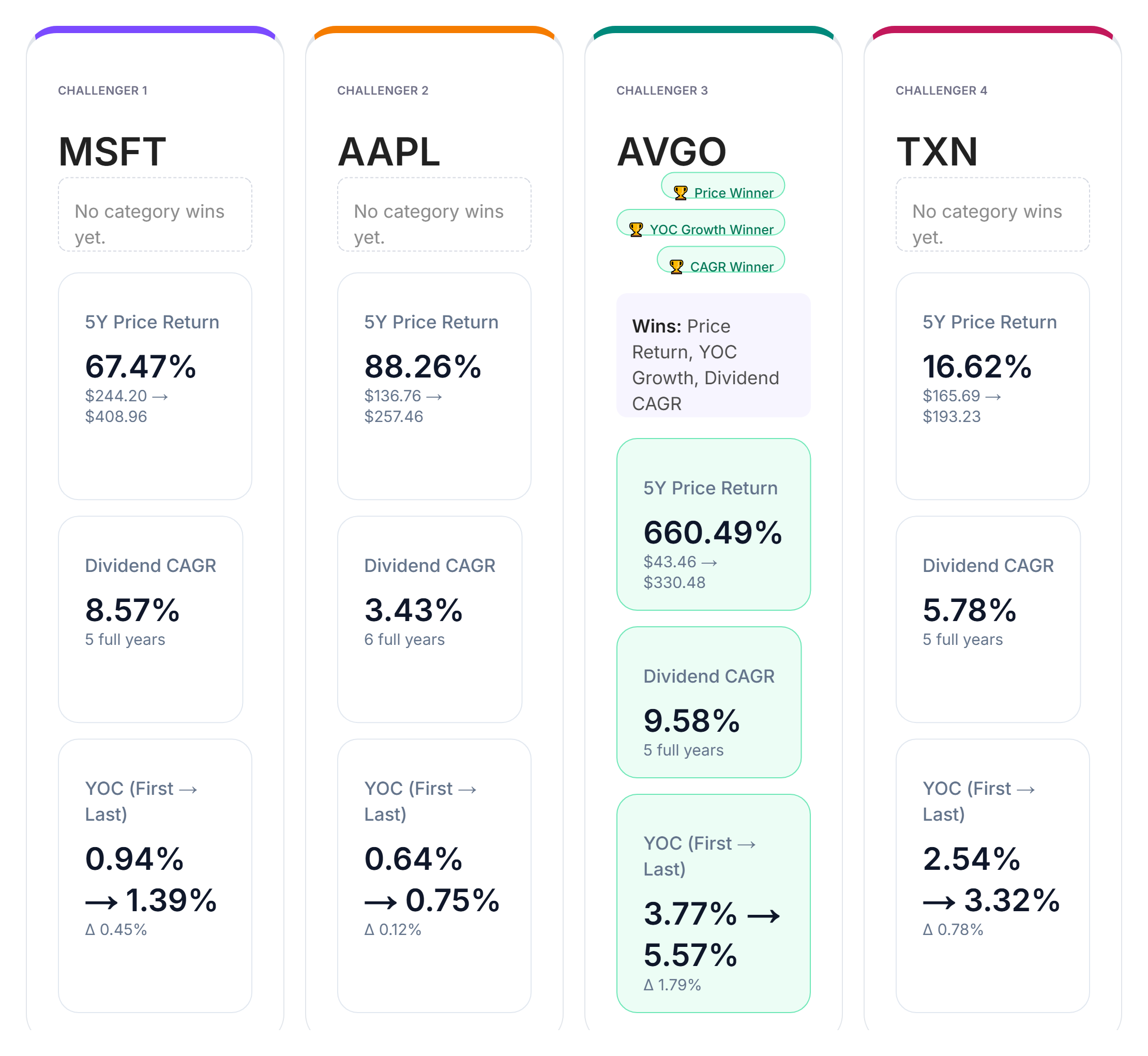
Looking at the data across dividend CAGR, yield-on-cost growth, and price return, a clear leader emerges in this comparison.
In dividend growth, Broadcom leads the group with a five-year dividend CAGR of 9.58%.
For yield-on-cost growth, Broadcom again shows the strongest improvement from first to last year, reflecting efficient income compounding relative to the original investment.
In price return, Broadcom also comes out ahead with a five-year return of 660.49%, significantly outperforming the other challengers in total appreciation.
Microsoft, Apple, and Texas Instruments all deliver solid results across these metrics, but none secure a category win in this particular battle. The results illustrate how aggressive dividend growth combined with strong business expansion can amplify long-term shareholder returns.
Yield-on-Cost by Year
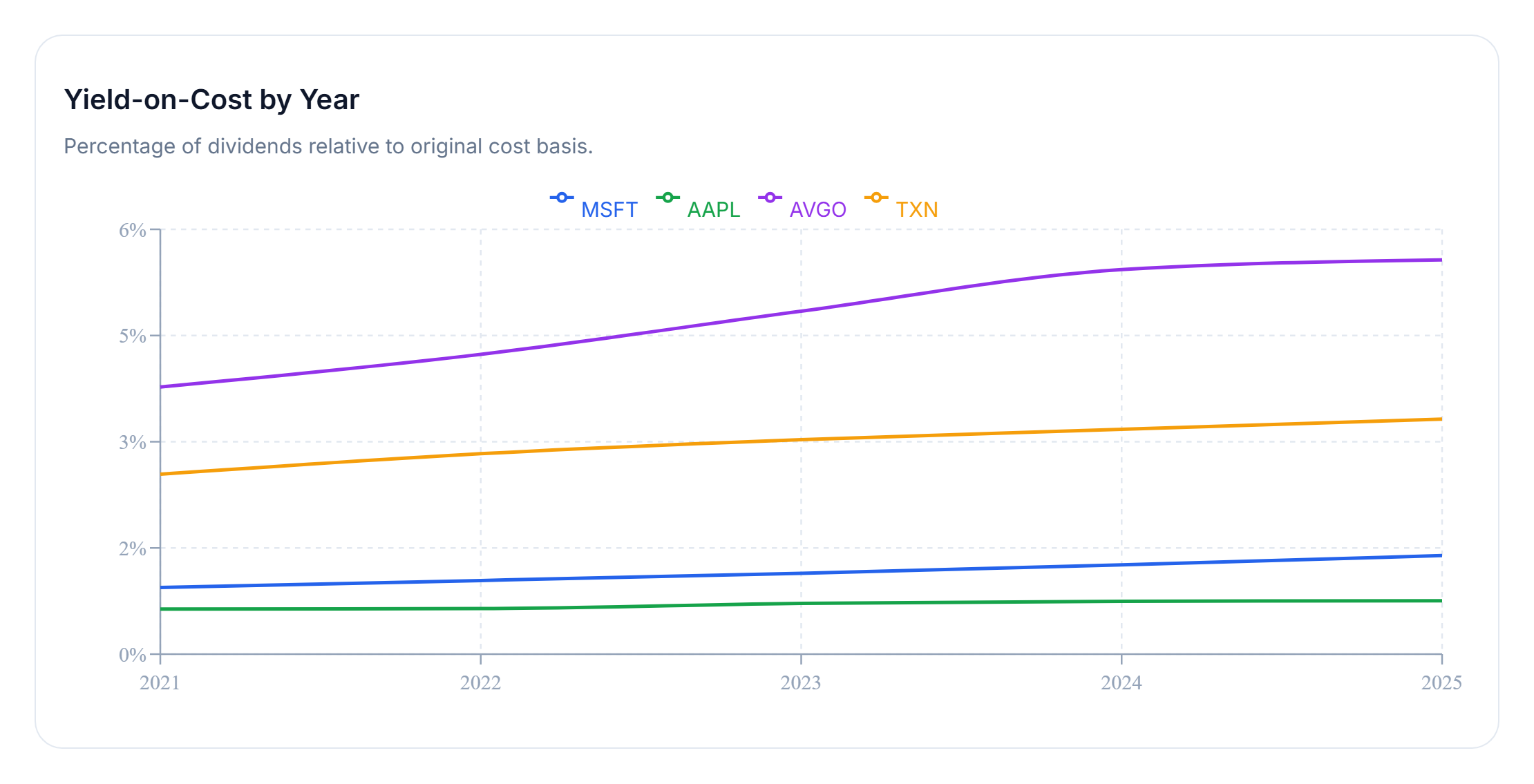
Yield-on-cost measures dividend income relative to the original capital invested. Unlike current yield, it shows how efficiently a holding grows income over time.
Over the five-year window, Broadcom stands out with the strongest income efficiency, reaching approximately 5.57% yield on cost by the end of the period.
Microsoft, Apple, and Texas Instruments all demonstrate steady upward income trends as well, but their growth trajectories are more gradual.
While the differences may appear modest early in the timeline, compounding dividend growth can significantly expand income generation over longer holding periods.
For income-focused investors, companies capable of consistently increasing dividends may gradually transform a modest starting yield into a much more meaningful income stream.
Final Takeaway
Technology companies are not traditionally known as high-yield dividend stocks, but several have become powerful dividend growth engines over time.
This battle highlights Broadcom’s exceptional combination of aggressive dividend growth and strong capital appreciation, allowing it to dominate across multiple income and performance metrics in this comparison.
Microsoft, Apple, and Texas Instruments still offer reliable dividend growth supported by durable technology businesses, but their income expansion has been more gradual.
For long-term dividend investors, the key takeaway is that strong dividend growth paired with durable cash flows can significantly accelerate income generation, especially when held over multi-year investment horizons.