SCHD vs VYM vs HDV vs SPYD: Dividend ETF Battle
Portfolio Overview
In this DividendXray battle, we compare four major dividend ETFs across income growth, yield-on-cost expansion, and total return performance over a five-year period.
- SCHD focuses on high-quality dividend companies with strong balance sheets and a long history of consistent payouts.
- VYM provides broad exposure to high-dividend U.S. stocks across many sectors.
- HDV targets companies with high yields supported by strong financial health and durable cash flows.
- SPYD emphasizes the highest yielding stocks within the S&P 500, prioritizing income generation over dividend growth.
Each ETF represents a different dividend investing philosophy, ranging from quality dividend growth strategies to high-yield income focused approaches.
Category Winners
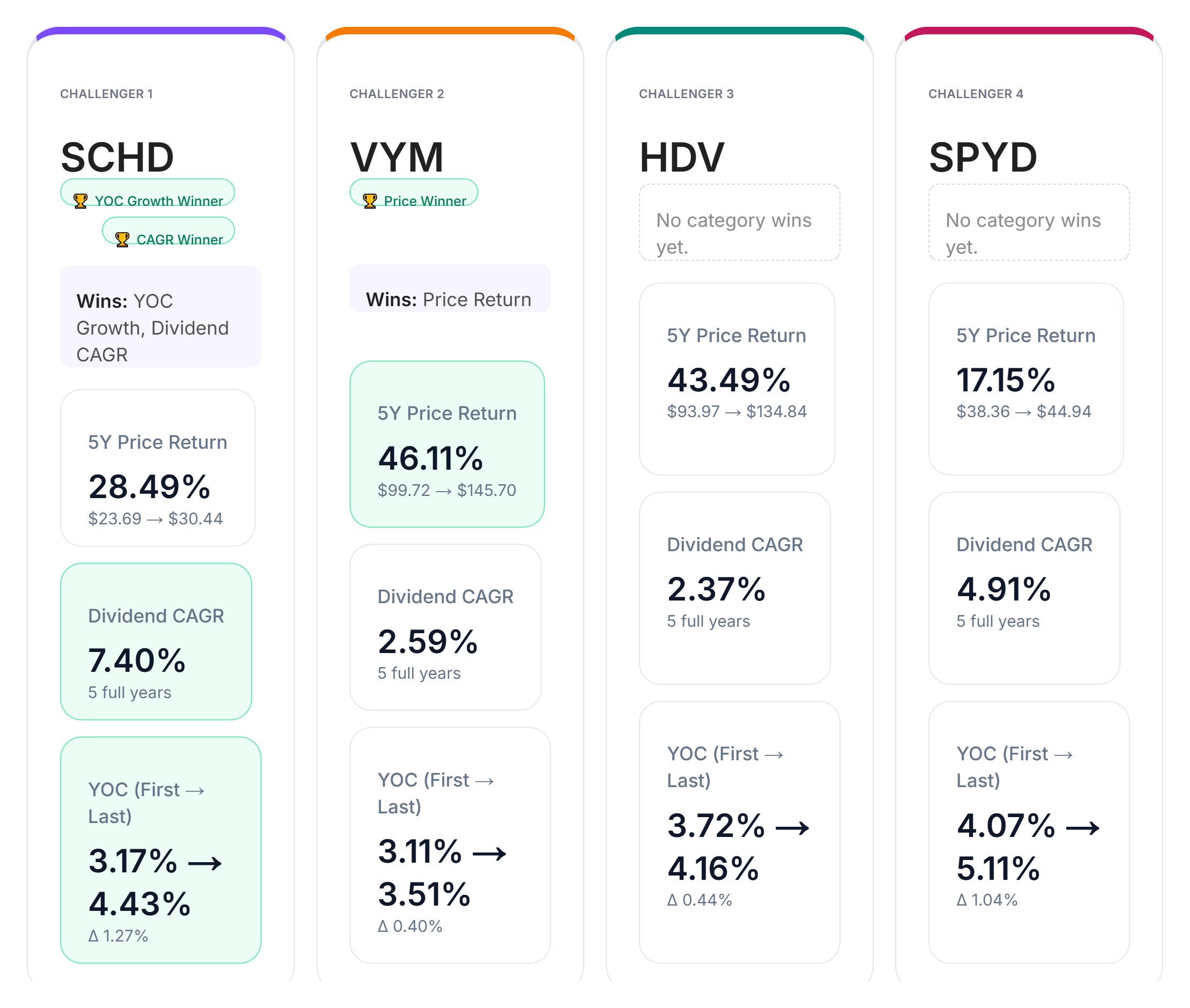
Looking at the data across dividend CAGR, yield-on-cost growth, and price return, several category leaders emerge.
In dividend growth, SCHD leads the group with a five-year dividend CAGR of 7.40%, reflecting strong income expansion over the period.
For yield-on-cost growth, SCHD again shows the strongest improvement from first to last year, highlighting its efficiency in compounding dividend income relative to the original investment.
In price return, however, VYM takes the lead with a five-year return of 46.11%, outperforming the other challengers in total appreciation.
HDV and SPYD both deliver solid results across the metrics, but do not secure a category win in this particular comparison. The results illustrate how different ETF strategies balance yield, growth, and total return.
Yield-on-Cost by Year
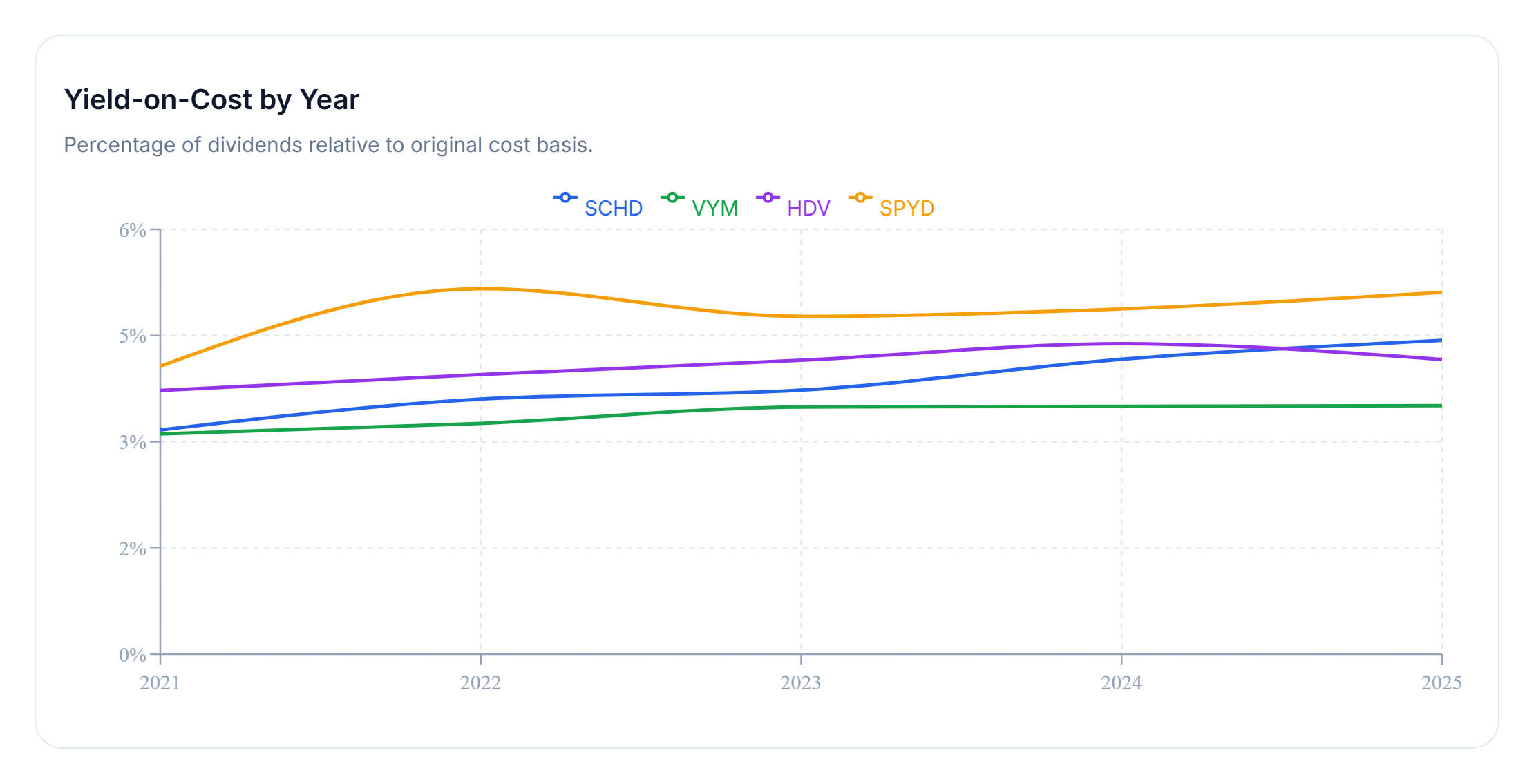
Yield-on-cost measures dividend income relative to the original capital invested. Unlike current yield, it highlights how efficiently a holding grows income over time.
Over the five-year window, SPYD stands out with the strongest income efficiency, reaching approximately 5.11% yield on cost by the end of the period.
SCHD, VYM, and HDV also show steady upward income trends during the same timeframe, although their income growth trajectories develop more gradually.
For dividend investors focused on long-term income expansion, these differences can become meaningful over time as dividend growth compounds and income streams expand.
Final Takeaway
Each of these dividend ETFs represents a distinct approach to income investing.
SCHD demonstrates strong dividend growth and yield-on-cost expansion, while VYM leads in total price return during this five-year comparison. SPYD delivers strong income efficiency, and HDV provides a balanced approach focused on financially strong high-yield companies.
The results highlight how portfolio outcomes can vary depending on whether an investor prioritizes dividend growth, high yield, or total return within a dividend strategy.
For income investors building diversified portfolios, understanding these trade-offs can help guide allocation decisions and long-term income planning.