QYLD vs QQQ vs SCHD vs VIG — Income vs Growth Dividend Battle
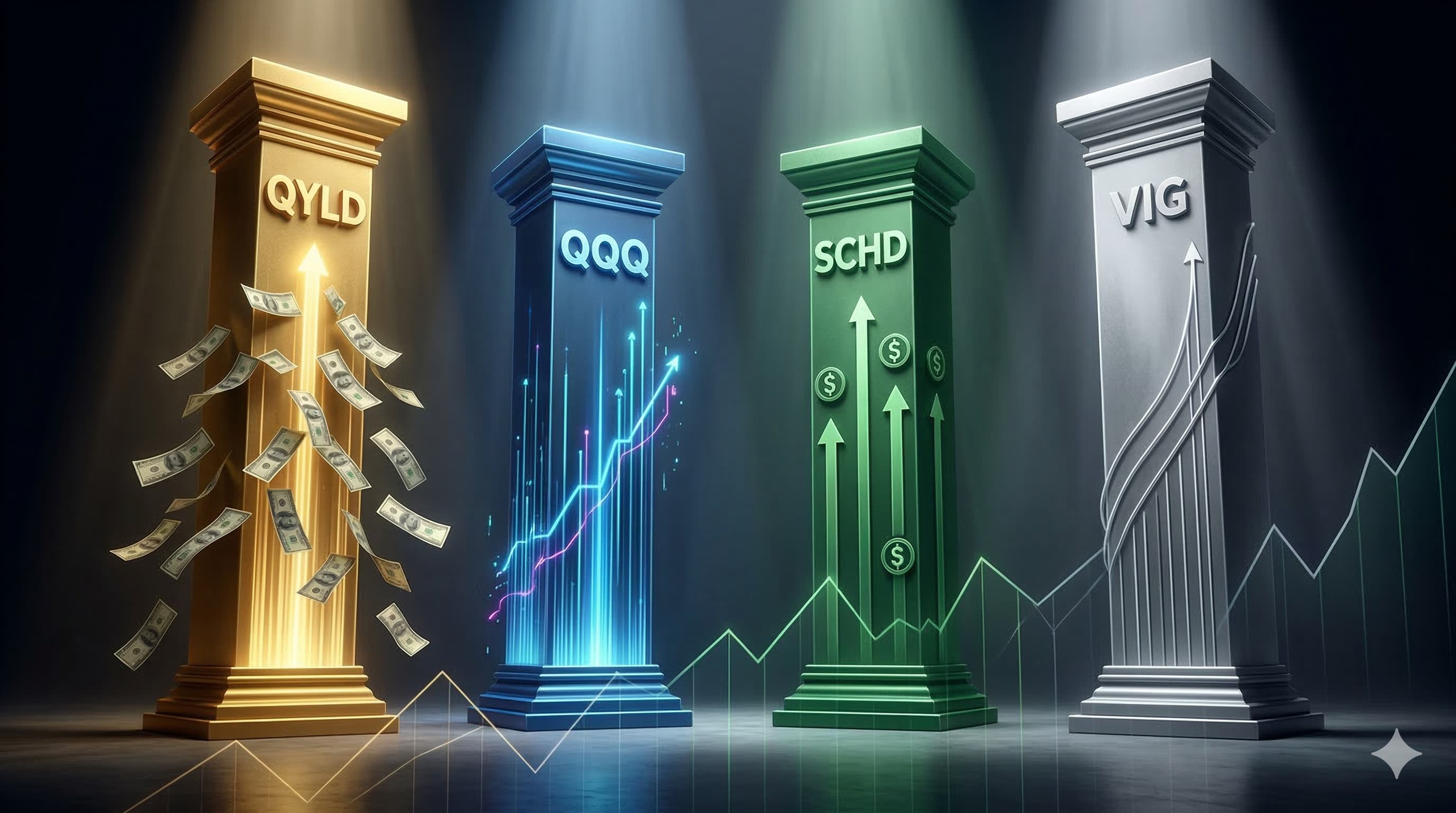
Portfolio Overview
In this DividendXray battle, we compare four distinct strategies across income generation, dividend growth, and total return performance over a five-year period.
- QYLD focuses on generating high monthly income through a covered-call strategy on the Nasdaq 100.
- QQQ tracks the Nasdaq 100 index, emphasizing growth and price appreciation from leading technology companies.
- SCHD targets high-quality dividend payers with a balance of yield, growth, and consistency.
- VIG prioritizes long-term dividend growth from financially strong companies with a history of increasing payouts.
Each holding represents a different approach — from maximizing current income to compounding long-term growth.
Category Winners
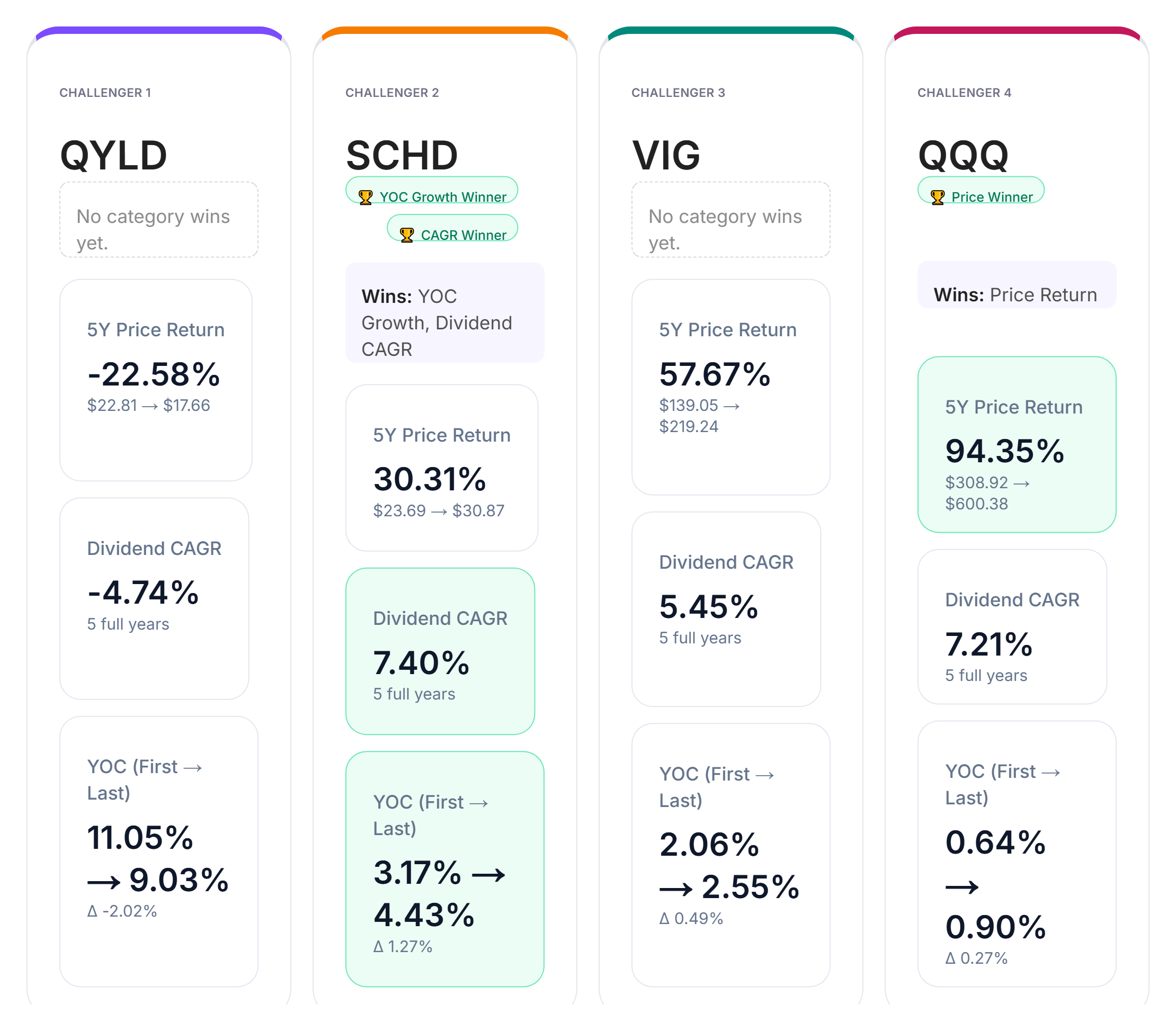
Looking at the data across dividend CAGR, yield-on-cost growth, and price return, clear category leaders emerge.
In dividend growth, SCHD leads the group with a five-year dividend CAGR of 7.40%.
For yield-on-cost growth, SCHD again shows the strongest improvement from first to last year, reflecting efficient income compounding.
In price return, QQQ takes the lead with a five-year return of 94.35%, significantly outperforming the other holdings in total appreciation.
The results highlight the trade-off between income-focused strategies and growth-oriented investing, with each ETF excelling in different areas.
Yield-on-Cost by Year
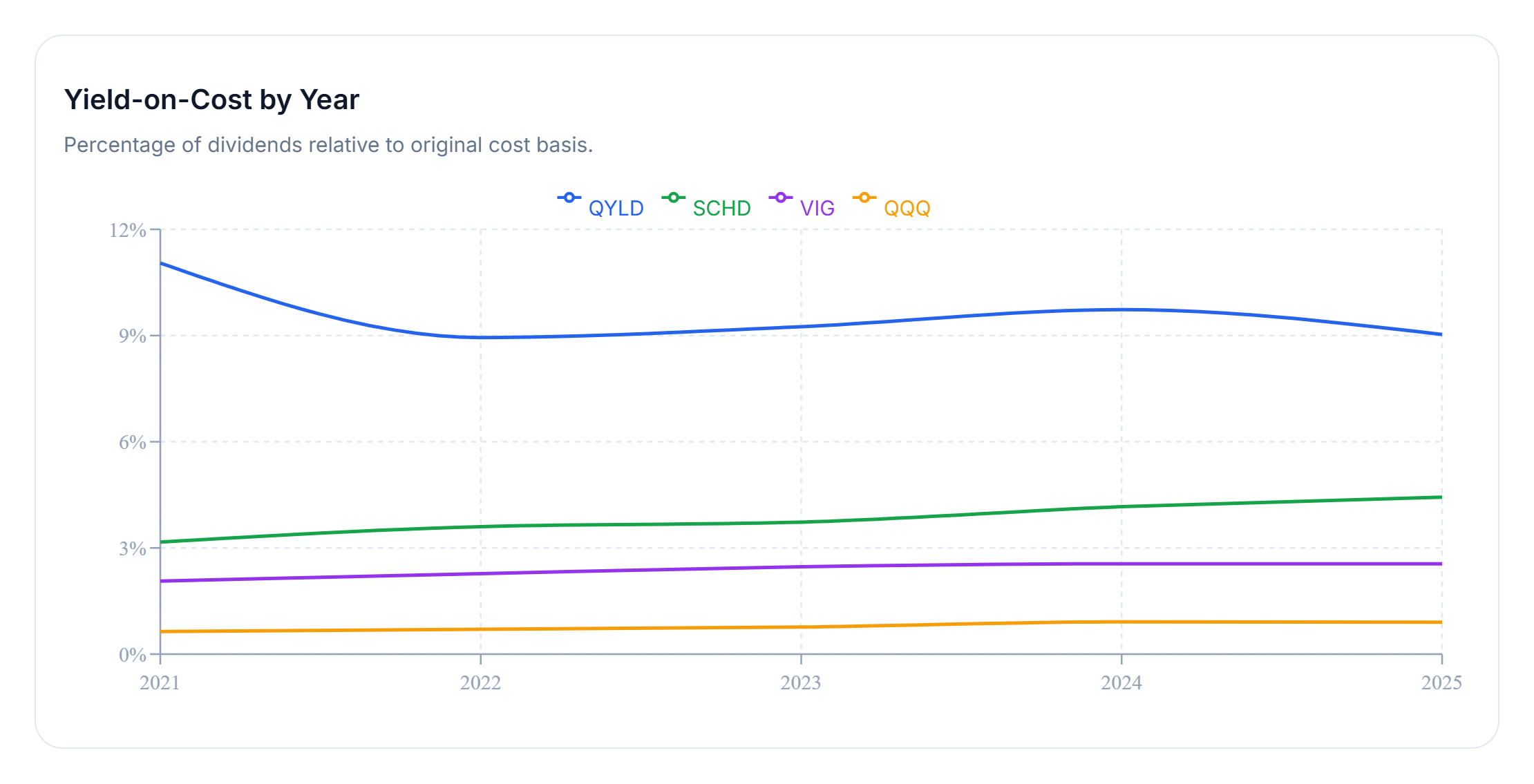
Yield-on-cost measures dividend income relative to the original capital invested. Unlike current yield, it reflects how efficiently income grows over time.
Over the five-year period, QYLD delivers the highest income efficiency, reaching approximately 9.03% yield on cost by the end of the period. However, its downward trend reflects the nature of its covered-call strategy, where option premiums can come at the cost of long-term NAV erosion.
The remaining holdings — QQQ, SCHD, and VIG — show more gradual but consistent upward income trends. While their starting yields are lower, their growth trajectories demonstrate stronger long-term income sustainability.
These differences highlight a key trade-off: immediate high income versus steadily compounding income over time.
Final Takeaway
There is no single "best" approach — only strategies aligned with different investor goals.
QYLD stands out for maximizing current income, making it attractive for income-focused investors. However, this comes with trade-offs in long-term growth and sustainability.
SCHD offers a strong balance of yield and dividend growth, making it a compelling option for investors seeking growing income streams.
VIG provides consistent dividend growth with a focus on quality and stability, while QQQ delivers powerful total return through growth-oriented exposure to leading technology companies.
Ultimately, the best choice depends on whether your priority is maximizing present income, building long-term dividend growth, or capturing total market appreciation.