MAIN vs STAG vs QYLD vs EPR Dividend Battle: Income Growth vs Yield Strategies

Portfolio Overview
In this DividendXray battle, we compare four income-focused holdings across dividend growth, yield-on-cost expansion, and total return performance over a five-year period.
- MAIN is a business development company focused on lending to and investing in lower middle-market companies while generating high monthly dividend income.
- STAG is an industrial REIT that owns logistics and warehouse properties across the United States and distributes steady monthly dividends.
- QYLD generates income by selling covered calls on the Nasdaq-100, prioritizing high yield over capital growth.
- EPR is a specialty REIT investing in experiential real estate such as entertainment venues, recreation properties, and attractions that produce income-focused dividends.
Each holding follows a different income strategy, ranging from high-yield option income to real estate cash flow and business lending.
Category Winners
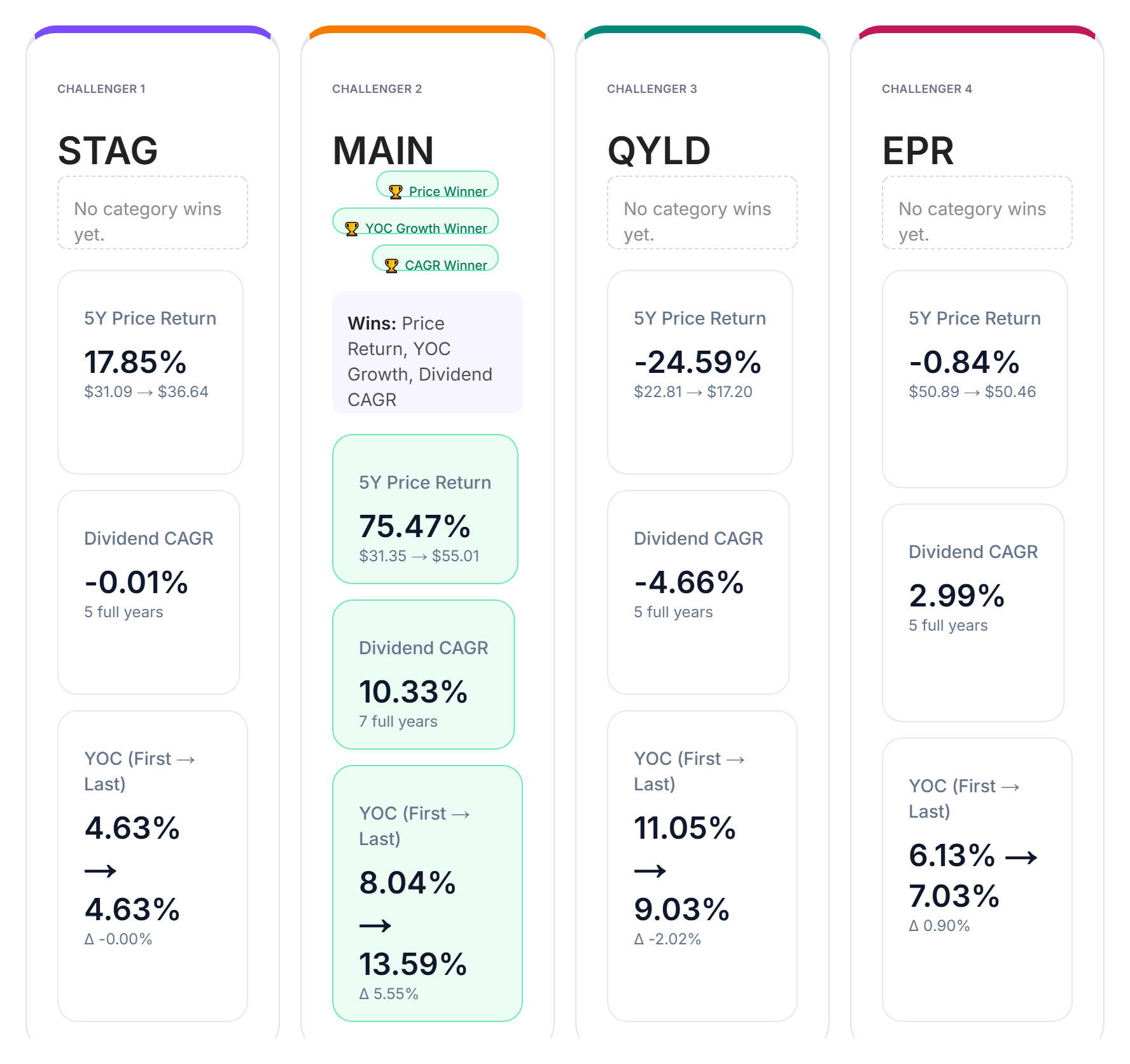
Looking at the data across dividend CAGR, yield-on-cost growth, and price return, clear category leaders emerge.
In dividend growth, MAIN leads the group with a five-year dividend CAGR of 10.33%.
For yield-on-cost growth, MAIN again shows the strongest improvement from the first to the final year, demonstrating efficient income compounding relative to the original investment.
In price return, MAIN also takes the lead with a five-year return of 75.47%, outperforming the other challengers in total appreciation.
STAG, QYLD, and EPR deliver solid results across income and yield metrics, but none secure a category win in this comparison. The results highlight how different income strategies can produce varying outcomes in long-term performance.
Yield-on-Cost by Year
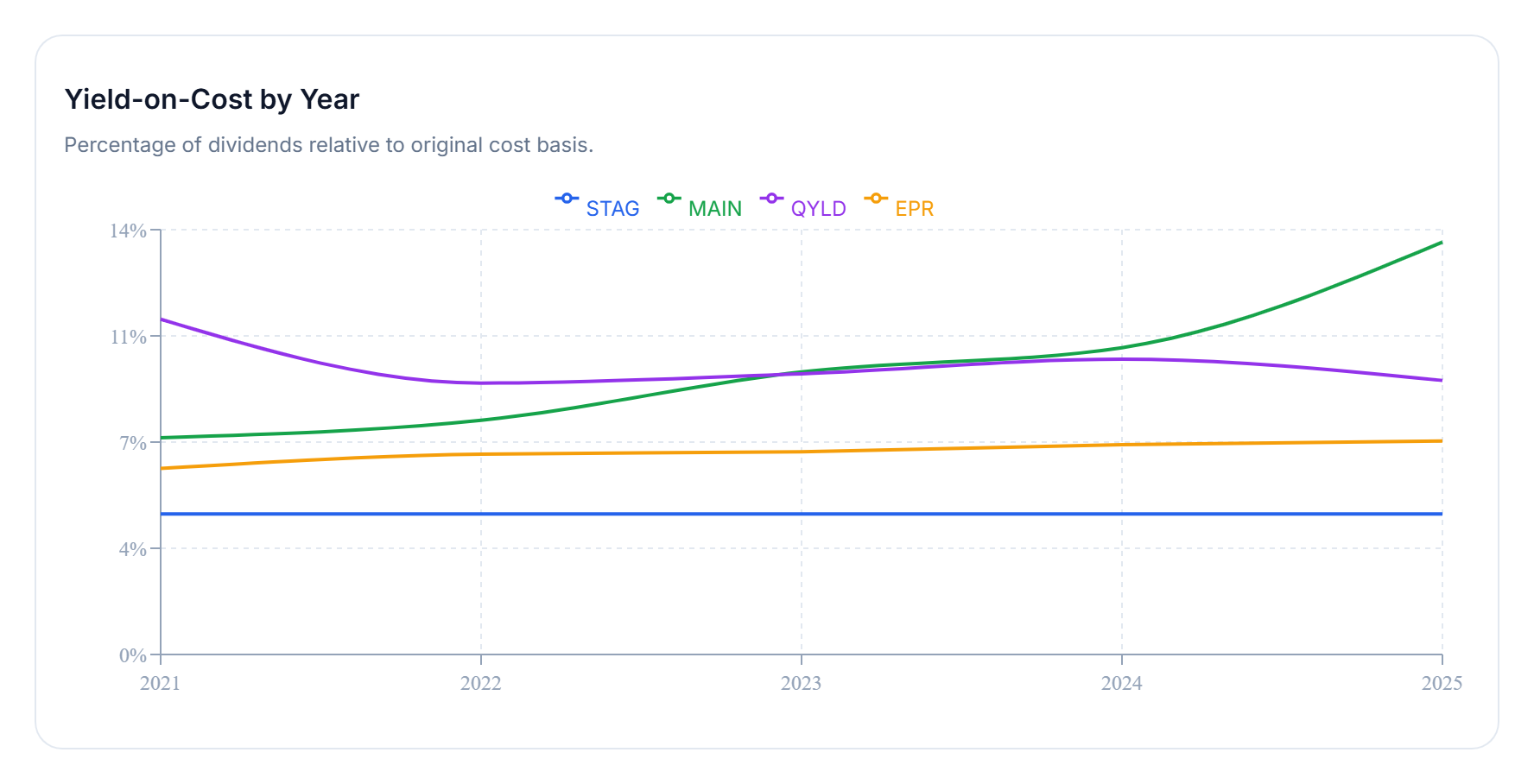
Yield-on-cost measures dividend income relative to the original capital invested. Unlike current yield, it shows how efficiently a holding grows income over time.
Over the five-year window, MAIN stands out with the strongest income efficiency, reaching approximately 13.59% yield on cost by the end of the period.
STAG and EPR show more gradual income growth trajectories. While their income profiles remain attractive for yield-focused investors, their dividend growth pace is slower compared with MAIN.
Even so, most holdings demonstrate upward income trends across the same five-year period, highlighting how consistent dividend payments can steadily increase income generation over time.
Final Takeaway
This DividendXray battle highlights how different income strategies affect long-term results.
MAIN dominates across dividend growth, yield-on-cost expansion, and price return, making it the strongest overall performer in this comparison.
STAG provides reliable REIT-based monthly income, QYLD focuses on maximizing yield through covered-call income, and EPR offers specialized real estate exposure tied to experiential properties.
For income investors, the results show that high yield alone does not always determine long-term income efficiency. Dividend growth and capital appreciation can play a major role in expanding income potential over time.