JPM vs BAC vs WFC vs C | 5 Year Dividend Battle
In this DividendXray battle, we compare four major financial and banking dividend holdings across income growth, yield-on-cost expansion, and total return performance over a five-year period.
JPMorgan Chase combines diversified banking, investment services, and capital markets exposure with a strong history of dividend growth. Bank of America provides broad exposure to consumer banking, wealth management, and interest-rate-sensitive income. Wells Fargo focuses on traditional banking operations while continuing to rebuild profitability and shareholder returns. Citigroup offers global banking and financial services exposure with a higher starting yield and significant international reach.
Each company approaches financial services differently, but all four aim to balance shareholder returns, capital growth, and long-term dividend income generation.
Category Winners
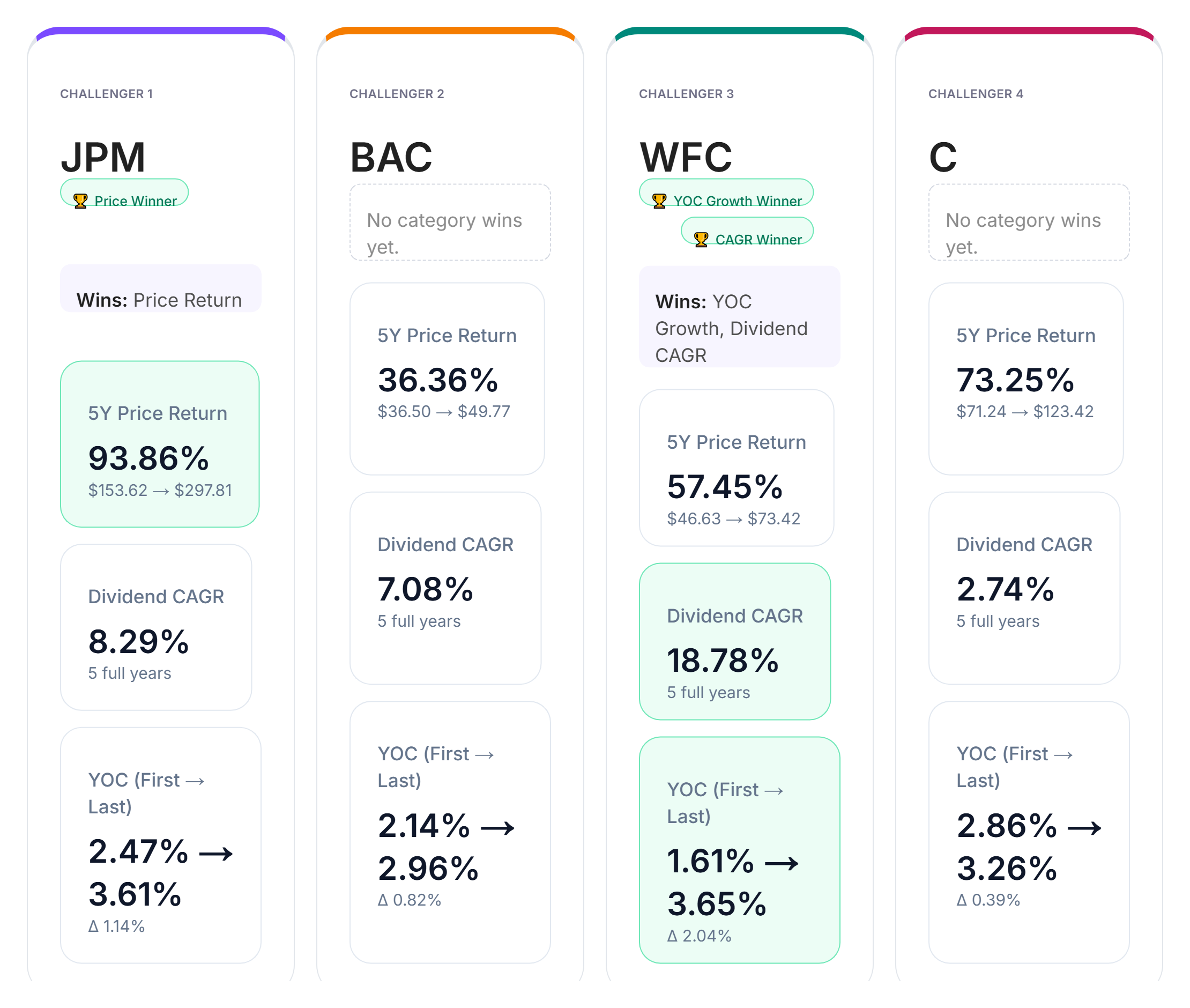
Looking at the data across dividend CAGR, yield-on-cost growth, and price return, clear category leaders emerge.
In dividend growth, Wells Fargo leads the group with a five-year dividend CAGR of 18.78%, showing the fastest pace of income expansion among these holdings.
For yield-on-cost growth, Wells Fargo again shows the strongest improvement from first year to last year, reflecting efficient dividend income compounding relative to the original investment.
In price return, JPMorgan Chase takes the lead with an impressive five-year return of 93.86%, outperforming the other challengers in total appreciation.
Bank of America and Citigroup still deliver solid overall results, but do not secure a category win in this comparison. The results highlight how differences in banking strategy, profitability recovery, and capital allocation shape long-term shareholder outcomes.
Yield-on-Cost by Year
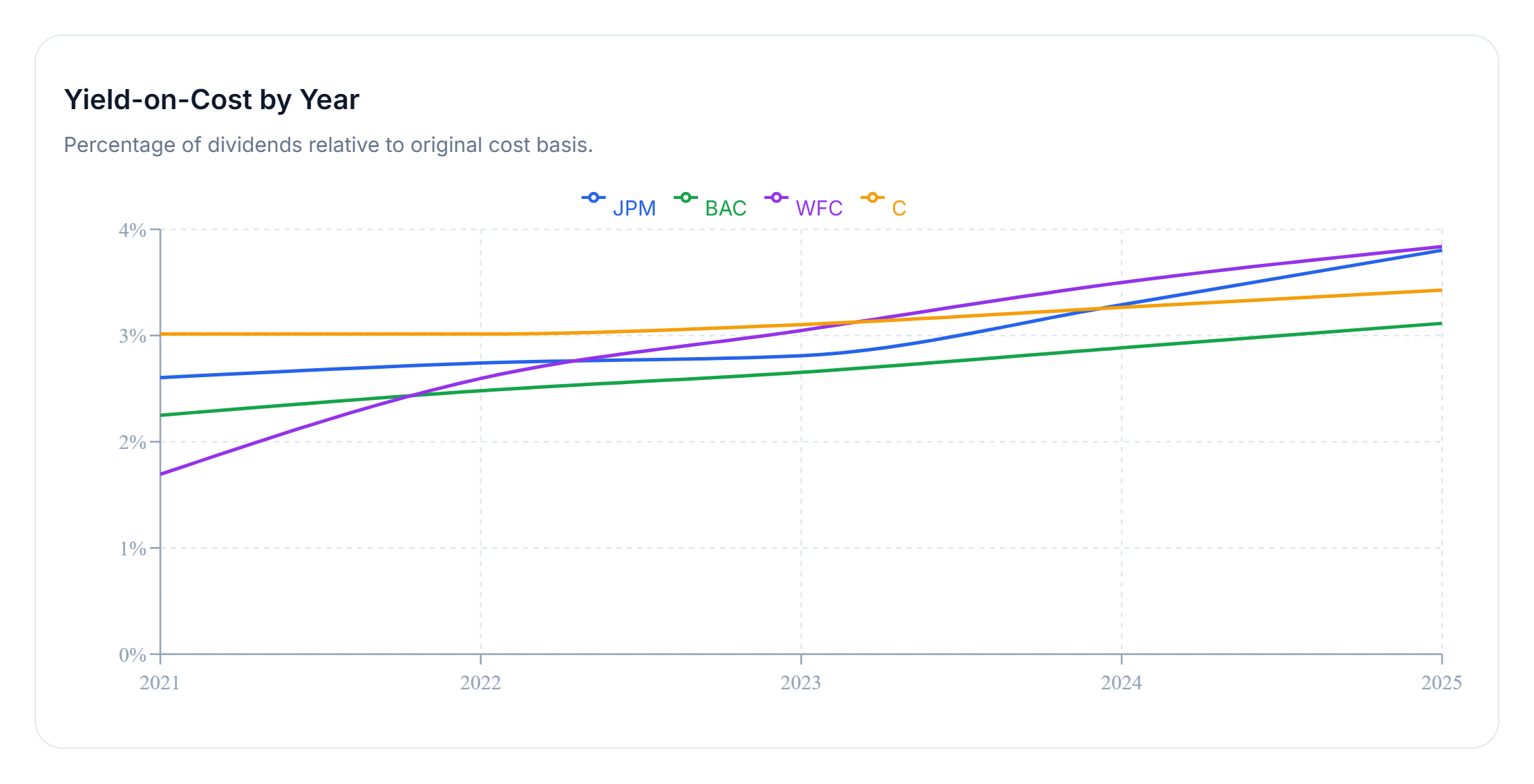
Yield-on-cost measures dividend income relative to the original capital invested. Unlike current yield, it shows how efficiently a holding grows income over time.
Over the five-year window, Wells Fargo stands out with the strongest income efficiency, reaching approximately 3.65% yield on cost by the end of the period.
JPMorgan Chase, Bank of America, and Citigroup also demonstrate steady upward income trends, although their trajectories are more gradual. Over longer periods, these differences in dividend growth rates can compound meaningfully for long-term income investors.
For dividend-focused portfolios, the balance between dividend growth, income consistency, and capital appreciation can significantly influence future portfolio cash flow — even without adding additional capital.
Final Takeaway
There is no single "perfect" banking dividend stock. Each holding reflects a different balance between income generation, dividend growth, financial stability, and long-term return potential.
This battle shows that Wells Fargo currently dominates income growth metrics, while JPMorgan Chase leads in total price appreciation. Investors focused on accelerating dividend income may prefer Wells Fargo, while those prioritizing broader business diversification and total return may lean toward JPMorgan Chase.
Ultimately, the best choice depends on whether your primary goal is maximizing dividend growth, increasing long-term income efficiency, or balancing both within a diversified financial sector allocation.