DIVO vs JEPI vs QYLD vs XYLD: Which Covered Call ETF Reaches $1,000 Per Month Faster?
Introduction
How much capital do you need to generate $1,000 per month in dividend income from covered call ETFs? The answer depends on the balance between current yield and future dividend growth.
In this breakdown, we compare DIVO, JEPI, QYLD, and XYLD against the same monthly income goal using the DividendXray income goal calculator. The objective is not simply to identify the highest yield, but to understand how different combinations of income today and income growth tomorrow affect the capital required to reach the same target.
Income Goal Comparison
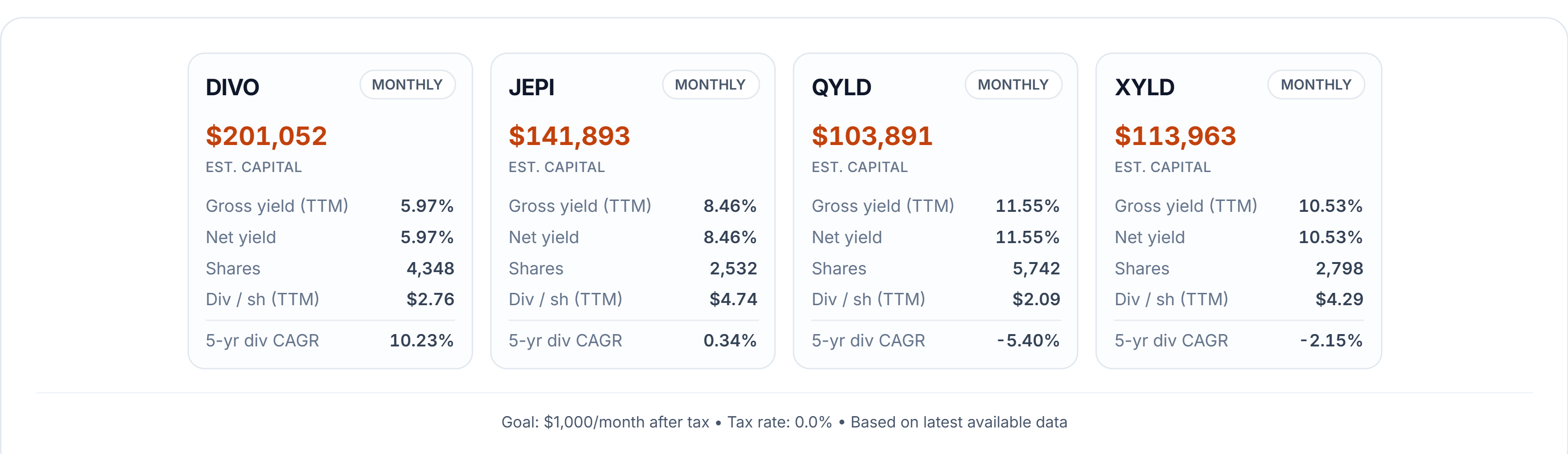
Here is a side-by-side comparison of how much capital each ETF would need to produce the same after-tax monthly income goal, based on current yield and tax assumptions.
For a $1,000/month after-tax target with a 0% tax rate, QYLD requires the least capital at approximately $103,891, supported by a yield near 11.6%. At the opposite end, DIVO requires approximately $201,052, reflecting its lower starting yield of roughly 6.0%.
JEPI and XYLD fall between these two extremes, offering a compromise between higher current income and stronger dividend growth characteristics. The comparison cards make the tradeoff clear: higher-yield funds can reach the income goal with less capital today, while lower-yield funds may offer advantages over longer holding periods.
Yield Catch-Up Timeline
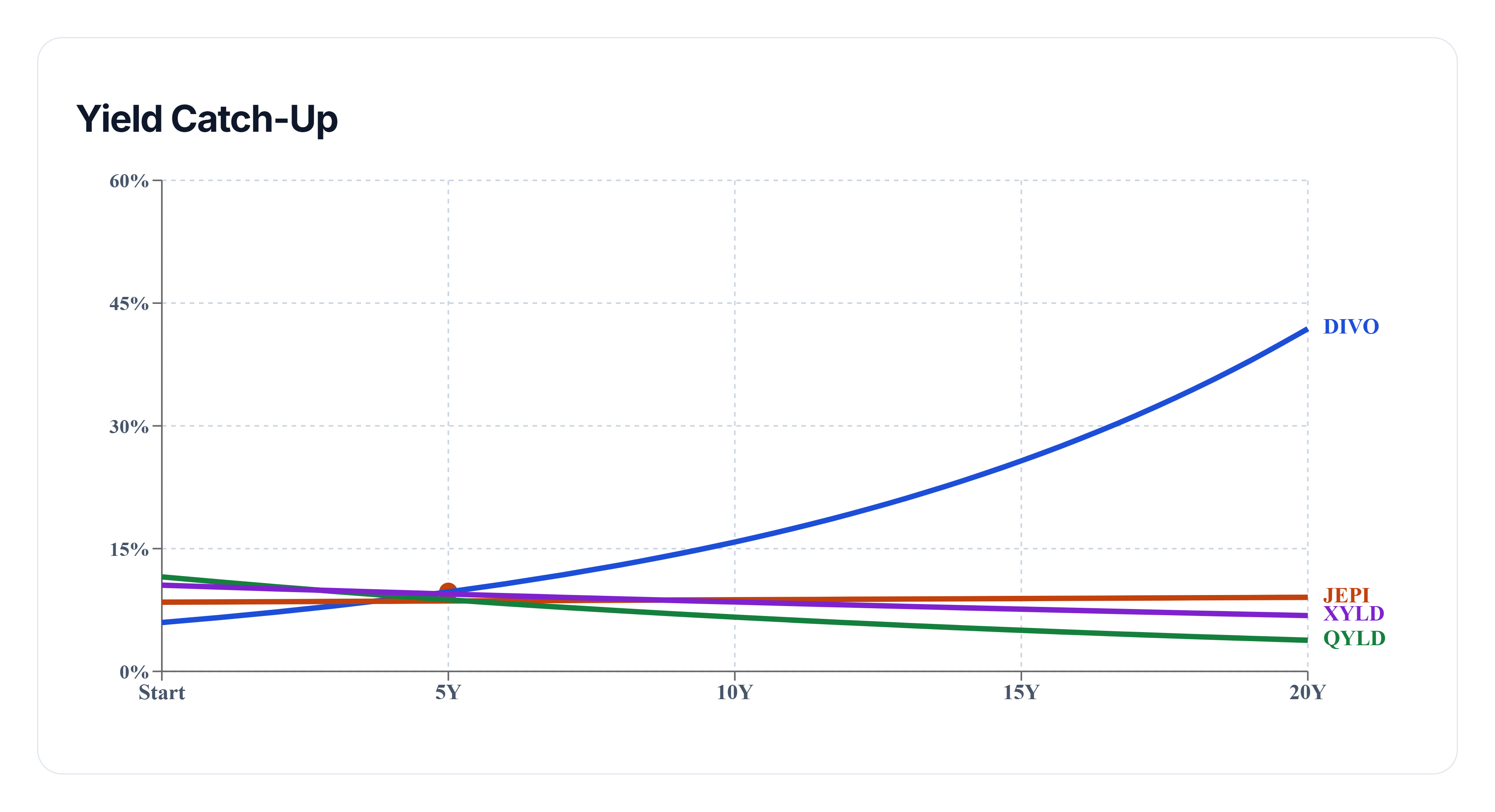
This chart shows how long it may take for a lower-yield dividend grower to match the income efficiency of a higher-yield alternative, measured by yield on cost.
QYLD begins with the highest yield at approximately 11.6%, giving it a substantial income advantage in the early years. DIVO, meanwhile, starts with a yield near 6.0% but delivers the strongest modeled dividend growth rate in this comparison at approximately 10.2% annually.
Based on historical dividend growth trends, DIVO gradually closes the gap and eventually surpasses QYLD on projected yield-on-cost around year five. The timeline highlights the classic tradeoff between maximizing income today and building faster-growing income streams for the future.
Final Takeaway
There is no universal winner among covered call ETFs. The best choice depends on whether you prioritize maximum current income, lower capital requirements, or faster long-term income growth.
QYLD offers the highest starting yield and requires the least capital to reach the income goal today. DIVO requires significantly more capital initially but demonstrates the strongest dividend growth profile in this analysis. JEPI and XYLD provide a middle-ground approach, balancing income generation with long-term sustainability.
Use the comparison cards to evaluate capital requirements today, and use the catch-up timeline to understand how dividend growth may influence income potential over time.